Newsletter July 1994
The Discovery of Noah's Ark
The Discovery of Noah's Ark
By Mary Nell Wyatt
NOAH'S ARK--The Early Years
In September 1960, 27 year-old Ron Wyatt, along with thousands of other people, read the following article in Life Magazine about an exciting boat-shaped formation in the region of eastern Turkey named Ararat:
"NOAH'S ARK?
Boat-like form is seen near Ararat
Boat-like form is seen near Ararat
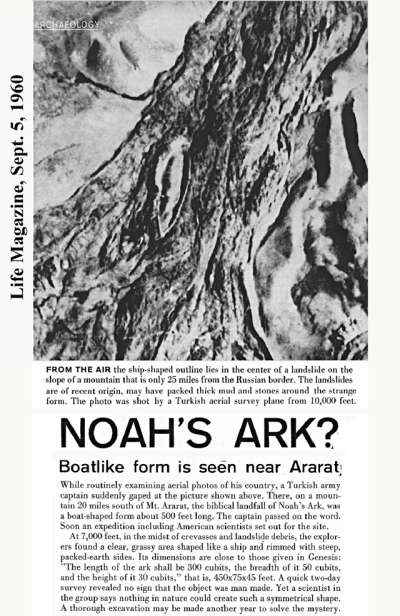
"While routinely examining aerial photos of his country, a Turkish army captain suddenly gaped at the picture shown above. There, on a mountain 20 miles south of Mt. Ararat, the biblical landfall of Noah's Ark, was a boat-shaped form about 500 feet long. The captain passed on the word. Soon an expedition including American scientists set out for the site.
At 7,000 feet, in the midst of crevasses and landslide debris, the explorers found a clear, grassy area shaped like a ship and rimmed with steep, packed-earth sides. Its dimensions are close to those given in Genesis: 'The length of the ark shall be 300 cubits, the breadth of it 50 cubits, and the height of it 30 cubits,' that is, 450x75x45 feet. A quick two-day survey revealed no sign that the object was man made. Yet a scientist in the group says nothing in nature could create such a symmetrical shape. A thorough excavation may be made another year to solve the mystery." LIFE
Ron's Decision is Made
At that time, Ron determined that one day, he would visit the site and see it for himself. But that was a dream he could scarcely realize anytime soon. He had a sixteen month-old daughter, a three month-old son, and within thirteen months, he would have another son. He was working as a lab technician in the quality control lab at Hercules Powder Plant in Kalamazoo, Michigan, and also attending Western Michigan University studying pre-med.
But soon family matters forced him to give up his hopes of becoming a doctor and he moved to Kentucky in 1964, where he entered nursing school. He graduated in 1967, and entered anesthesia school and graduated as a Certified Registered Nurse Anesthetist in 1970. It was also in 1970, that he found himself raising his three young children alone.
It didn't look like there would ever be any opportunity for him to visit the boat-shaped site, so he had to limit his archaeological research to libraries and book stores. But he never lost interest -- in fact, he studied everything concerning ancient history and archaeology, not just subjects concerning Noah's Ark.
He had found that there was very little information available on the subject of Noah's Ark, which convinced Ron more than ever that no serious research had ever been undertaken on the subject. Everything he had read was based on folklore and unsubstantiated claims, and all the sightings were in different locations.
Hawaii
From 1973 to 1975, he and the children lived in Hawaii, where he was able to study volcanoes firsthand. This convinced him that if the ark had landed on the volcanic peak called Mt. Ararat, that it would have been destroyed long ago. Despite the fact that there are those who have written elaborate explanations of how the ark could have survived on the volcanic peak, we learned later that the eruption of Mount St. Helens showed that NOTHING could survive on a volcanic mountain such as Ararat. If the ark had ever been there, he concluded it would have long ago been destroyed.
Building Mountains
Moving back to the mainland in 1975, he decided that there was one form of research that he could do -- he built a small boat model the same ratio as the ark as stated in the Bible, and then he built various mountain configurations in a stream.
By floating the model down the stream, he observed the boat's reaction as it approached the various rock shaped "mountains". What he learned was that when the boat approached a simple peak extending out of the water, it simply floated around it, not approaching it or certainly not landing on it. This was the law of physics known as the "lateral displacement" of an obstructed gas or liquid flow.
He continued this experiment with several shapes with the same result each time. That is, until he built a crescent-shaped formation, with the crescent concave side facing down-stream. When the boat accelerated around this crescent-shaped mountain, he saw that it was pulled into the area within the crescent by the eddy effect, whereupon it gently floated within that area.
With this bit of information, Ron felt like the ark would have harbored in such a location. The laws of hydrodynamics and water action and reaction were the same then and now. If the ark had approached a mountain peak extending out of the water, the water displacement around the mountain would have carried the ark with it.
The study of water as a fluid, with its unique properties, and the study of hydrodynamics (fluid mechanics) and wave causation and motion is a most involved and complicated science. The actions and reactions of water and an object floating on that water cannot possibly be studied in-depth here -- but some simple rules must be understood.
If your ship on the open sea approaches a mountain extending out of the ocean, only one of two things can happen:
1) The ship will be carried around the mountain with the lateral water displacement, or
2) The waves can be of such force and direction that they carry the ship right into the side of the mountain, with such force that the ship would break into pieces.
But it would NOT come to rest on that steep mountain side. It just wouldn't happen. If that mountain peak were directly under the ship and the waters slowly descended, the ship STILL wouldn't land on the mountainside (such as on Mt. Ararat). The water displacement and movement around the underwater mountain would still cause the ship to be removed from the mass (of the mountain) with the water.
The necessary criteria for a ship to land on a mountainside as sea waters descended, would involve a process by which the water displacement would trap the ship within an area, such as an eddy could do. At least, that's what Ron believed and later found to be true, based upon the formation of the mountains at the ark site.
The Size of the Ark
One of Ron's favorite subjects of study was the ancient Egyptians, as they related to the biblical account. While in Hawaii, he had read everything he could find on the subject in the library.
And as he mulled over all the information in his mind, there was one thing that seemed to be obvious to him: He knew that Moses had been the author of the Genesis account and therefore the flood story - and as such, Ron believed that the type of cubit Moses would have been accustomed to, would have been the Royal Egyptian Cubit, the most universal standard of measurement in the ancient world at that time. There was no Hebrew Cubit in existence during Moses' time, and to Ron, the 500 foot measurement given in the Life article was even more compelling evidence that the site needed thorough exploration. After all, 300 Royal Egyptian Cubits equals 515 feet which is similar to the ark formation, but the Hebrew Cubit is only 450 feet and comes into existence much later after Moses.
1975- The Ark File
It had now been 15 years since he had read that article, but his interest never waned -- it only grew. Then Ron read the book, The Ark File by Rene Noorbergen, who just happened to be a member of that 1960, expedition to the boat-shaped formation. Until this time, Ron had no more information on the boat-shaped object other than what he had read in Life Magazine, but now he knew the names of the very men who visited it.
So, he contacted all but one of the American members of the expedition and gleaned from them everything they could tell him. When he told them he wanted to visit the site, they all basically told him he was crazy to do so. They were all adamant that nothing was there- that is, all except one man, Dr. Arthur Brandenburger who still believed it was a ship.
He asked them how to get to the site- after all, "20 miles south of Mt. Ararat" is a pretty vague location in a region that is very mountainous. But no one could tell him exactly how to get there because they had ridden on horseback for many hours to the site, while being led by the Turkish military.
1977 -- Time to Go to Turkey!
In 1977, for the first time, Ron felt like his children were old enough for him to either leave them alone at home or take them with him to Turkey. For the first time he had two weeks of vacation from his job, while also having enough money to go to Turkey.
It was now 17 years since he first read about the site. He told the children what he was about to do and to his dismay, the boys, Danny who had just turned seventeen, and Ronny who would be sixteen in 2 months, insisted on going too. Torn about whether to take them or not, he did the only thing he knew to do -- he said a little prayer that if the boys were supposed to go, that they would receive their passports before the departure date, AND, there would be seats available on the chartered flight from New York to Istanbul.
He had been told that he had booked the last seat on the flight, and when he called to check on availability, he was again told that none were available. It was now within a week of his departure date. But two days later, he received a call from the airline - it seemed that two seats had come open at the last minute and he was asked if he wanted them. There was still the matter of the boys getting their passports, a procedure which usually took several weeks. But in three days, Danny's was back, and the next day Ronny's arrived. Yes he wanted the seats.
But Where Is It?
On August. 9, 1977, they arrived in Istanbul, Turkey. Things were a lot different then than they are today -- they had to take a bus to Ankara, and then a train to Erzurum. This consumed three valuable days and they were still not in Dogubeyazit, the little town near the ark site. In Erzurum, they took a taxi to Dogubeyazit, directing their driver to take them to a hotel there. But Eastern Turkey is no thriving tourist area. It is remote and dangerous. Very few people speak English. How would they ever find the boat-shaped object in the few days they would have there?
Many people may find Ron's method of getting information strange, but again he did the only thing he knew to do -- he prayed about it. He told the boys to say a prayer that the taxi would stall at the place where they were to begin looking for the ark. After all, their taxi driver spoke no English, they didn't know if anyone in the town could speak English -- and even if they did, would anyone know where this boat-shaped object was? It had been seventeen years since the expedition had come there- perhaps the townspeople had forgotten all about it.
The Stalled Taxi
They all prayed -- not some great elaborate prayer, but just short, silent prayers for help. To Ron's way of thinking, if Noah's Ark was real, then the rest of the Bible was surely just as reliable, including everything said about prayer. As they approached the town, the taxi stalled.
Full of excitement at seeing their prayers answered, they all three climbed out of the taxi and piled a great number of rocks on the side of the road as a marker, while the bewildered driver peered under the hood of the taxi. When they all got back in the taxi, it started up and they continued on down the road.
Soon it stalled again. With a little bit less enthusiasm, they again piled up rocks on the roadside. Again, the taxi started up when they all got back in. Finally, it stalled again, and thinking that perhaps they had just gotten a defective taxi, they each placed one rock in a pile along the side of the road. This done, they headed to the hotel.
It was late when they arrived at the Erzurum Hotel in Dogubeyazit. They all fell asleep, completely exhausted from their long journey. The next morning, they hired another taxi and headed back to the third and closest pile of rocks, where they began walking in a perpendicular direction from the road.
DAY 1- The Anchor Stones
They soon came to a small village where several very intimidating men approached them, one with a shotgun. Communicating in hand gestures, Ron convinced the men that they were just tourists. Soon the villagers appointed themselves Ron's tour guides.
Walking over miles and miles of rugged terrain, one of the men motioned for Ron to take his photo by a very large, standing rock. Only when he looked through the viewfinder did Ron realize that this rock was identical to the ancient ship anchor stones found in the Mediterranean Sea that he had seen in archaeological books. That is, except for one thing -- this "rock" was many, many times larger!
When he examined it more closely, he saw that it had eight crosses carved on it. When the villagers saw Ron's interest in this, they showed him several more in the area -- all exactly like other ancient anchor stones except again, many, many, times larger -- and most with crosses carved on them.
They were all terribly excited by what they had seen, but the boat-shaped object was nowhere in sight. As they continued to walk, they showed Ron and the boys a very ancient graveyard which had strange monuments in it which looked like simple representations of a three story boat. Were these objects connected to Noah's Ark? Ron believed they were. He photographed and filmed everything with his 8mm movie camera (No video cameras back then!) and they decided to head back to the hotel for the night.
DAY 2 -- The House and Fences
The next morning, they returned to the second pile of rocks and began to walk out from the road in a perpendicular direction again. This pile wasn't too far from the first and they soon found themselves looking at the walls of a very, very ancient stone house whose floor seemed to be set about four feet into the ground, as topsoil had covered it over the years. The roof was gone and it was apparent that no one had lived here for a great number of years.
Radiating out from the house was a very large pattern of stone fences which seemed to go on for miles. These too seemed to be covered by several feet of dirt with only the upper part extending above the earth.
The Tombstones
The most interesting feature of this site were the objects in the front yard -- there were two large stones, one standing upright and the other lying flat on the ground. Carved on these stones was a most exciting picture: across the top of each was an arc-shape [rainbow]; below this was a curly-cue which looked like an ocean wave, and atop it was a very simple boat-shape; walking away from this boat and wave were eight people -- the first and the largest was Noah; next and second largest was Mrs. Noah; the next three were all slightly smaller - representing the three sons of Noah; and the last 3 were slightly smaller and represented the wives of the sons.
It seemed quite obvious to Ron that these were iconographic representations of the eight survivors of the flood, all walking away from the ship with a rainbow overhead. But what did it all mean?
When he studied these two large monuments more closely, he noted that on the one lying on the ground, the largest woman - representing Mrs. Noah, had her eyes closed and her head tilted downward. On the larger tombstone which was still standing, he saw that BOTH the first woman AND the first man (Noah) had their eyes closed and heads tilted downward. Since these were in front of the house, he believed they were the actual tombstones of Noah and his wife!
The iconography showed that FIRST Mrs. Noah died, and on her stone only her eyes were closed. When Noah died, BOTH of them were represented as dead.
Ron felt that what he and the boys had found these first two days was extremely important. While they didn't prove anything about the boat-shaped object, there were clear indications that a family of eight people had lived in this exact area during some ancient time. The eight-cross design on the anchor stones showed that someone during the Christian era had identified these huge rocks with the ark and its eight passengers.
The Search for Noah's Ark, part 2
The Fences -- Evidence of Noah's "Husbandry"
The ancient house -- was it Noah's? They only had one morning to examine everything pertaining to the house, but the thick walls and the vast pattern of stone fences was pretty compelling evidence. The Bible gives reference to Noah being a "husbandman":
Genesis 9:20-23 "And NOAH BEGAN TO BE AN HUSBANDMAN, and he planted a vineyard: And he drank of the wine, and was drunken; and he was uncovered within his tent. And Ham, the father of Canaan, saw the nakedness of his father, and told his two brethren without. And Shem and Japheth took a garment, and laid it upon both their shoulders, and went backward, and covered the nakedness of their father; and their faces were backward, and they saw not their father's nakedness."
This passage tells that Noah was in a tent, not a house such as Ron had found. But Ron learned that the inhabitants of this region, as in other pastoral societies, still live in tents in the summer and in thick stoned houses in the winter. This seems perfectly consistent with the mention of a vineyard, which would have yielded its fruits in the warmer season
"Husbandry" is defined as "farming, as of livestock" (Random House Dictionary). After the flood, it makes perfect sense that Noah bred the animals and cared for them until the point in time that their numbers were sufficient enough to eliminate the likelihood of their becoming extinct. With only two of each unclean animal, if even one should not survive, that animal would become extinct. And the extremely large pattern of stone fences radiating out from the house, and extending on for a good distance seemed consistent with this type of activity. The depth below the present ground level of the house and fences shows their great antiquity. Over the years, windblown dust and dirt raised the ground level, thus burying or partially burying ancient surface structures.
What Noah Wore
In the above Scripture, we also included the entire passage which tells about Noah becoming drunk and having his "nakedness" seen by Ham. We included this because of one tiny point: The pictographs on the tombstones in front of the house show the men wearing a type of tunic. This is entirely consistent with Noah's nakedness being seen when he became drunk- if he had had on pants or slacks like men wear today, he would have remained covered, no matter how he may have been lying down in his drunkenness. But with a tunic, like a dress, this would not be the case.
The Giant Altar and Its Complex
The house is located in an incredibly beautiful plain which runs east/west. To the north and south are mountains. Unlike our country, most of the terrain is rock in this region, especially in this isolated area, except for the village where the anchor stones were located. But when Ron and the boys looked behind the house to the north, they saw a very beautiful mountain ridge -- directly behind the house.
This ridge had two small hills which met and formed a valley in between them on the side of this ridge. In the middle of this mountainside valley, Ron saw a VERY large square rock which looked as if it had been deliberately set in that location. Behind this large rock the valley formed a natural amphitheater. On the side of this very large rock was a complex of small fenced-in areas.
If this was really Noah's house, this certainly looked like a very large altar with room for a large number of people to sit behind it as the sacrifices were made.
Genesis 8:20 "And Noah built an altar unto the LORD; and took of every clean beast, and of every clean fowl, and offered burnt offerings on the altar."
The altar itself measures 12' x 12' x 12' and it has one step. When we stood upon it, it was obvious that whoever stood upon this altar was quite a bit taller than we are, for the step is about three feet high. The complex of pens adjacent to the altar also indicates that whoever arranged the rocks in this pattern was very, very strong, because today many of the large rocks could not possibly be moved by humans without mechanical assistance. At one point, a very large boulder is balanced upon several upright stones, forming a covered area that a six foot tall man can walk under without stooping.
Also in this complex are two very large stones which display features which indicate that they were used for the slaughter and bleeding of animals. (Genesis. 9:4) One is consistent with the size of smaller animals like sheep and goats; the other, much larger, is consistent with the size of larger animals, such as bullocks. They both have a series of chiseled-out indentions leading from the ground to the flattened, slightly angled top. These indentions are the size that is consistent with animal hooves. Perhaps the animals were led up the side of these rocks to the top, which also contain chiseled out basins with drains, that are consistent with areas for bleeding the animals prior to offering them on the large altar stone. According to the biblical account, specific parts of the animal were offered as sacrifice, then other parts were cooked and eaten "before the Lord." (See Leviticus, chapters 1-9.)
DAY 3- the "Boat-Shaped Object"
Ron filmed and photographed everything. There is actually much more than we have listed here, but these are the most important items. At the end of day two in the ark region, they had seen more than enough to make the trip worthwhile. The next day would be their last.
Arising the next morning, the boys were tired and stayed in the hotel room. They had traversed across a great number of miles in the previous two days and Ron knew they needed a break. So he got a taxi and returned to the first pile of rocks. They had worked their way backwards from the third pile to the first. And this one was quite a distance from the others.
This time, Ron had the taxi driver take him as far as he could go in the direction that was perpendicular to this rock-pile. They traveled up into the mountain range to the south, as far as there was a dirt road. When it ended, Ron began to walk. With mountains everywhere, he wondered if he would ever be able to spot the boat-shaped object if he looked right at it- but soon he saw it. And what he saw convinced him more than ever that this object was the remains of a ship. But, what he saw also convinced him that there was only one way to explore its true nature, and that was by an excavation to remove the soil which covered it.
He returned to the hotel room and they packed their things. He checked out that night so they could leave early in the morning -- but that proved to be a big mistake. In 1977, there weren't any tourists to speak of in this region. It is desolate and very foreboding. The Kurdish villagers had been watching Ron and the boys, waiting to make their move. As long as they were staying in the hotel, they were spending money -- paying taxis and guides. But these bandits wanted it all, and as soon as they realized Ron was about to leave, they attacked.
It's a long story, but to summarize it, Ron and the boys heard robbers coming up the steps banging pipes and making a lot of noise. Shoving the furniture in front of the door, they tied the bed sheets together and climbed out their third story window onto a roof below. There, they climbed back into the second floor window which led into the kitchen, and they ran through the hotel and out the door.
In the commotion, they lost almost all of their film. Ron did manage to hang on to some of the movie film. Once they were safely out of town, they realized how truly dangerous the region was. The boys would never go there again -- and after all they went through, they would never see the "boat shaped object" in person.
Back at Home -- Now What?
Ron had gone to Turkey for one reason -- his own personal curiosity. What he saw, fueled his resolve to investigate the site more thoroughly, but as a private individual, he had no idea where to start. He knew the site needed to be excavated, but how could someone like himself get permission to do so? And how could he interest important scholars and archaeologists in the site when most people believed that if the ark existed at all, it had to be on Mt. Ararat?
Dr. William Shea
In 1978, someone told Ron about another man who was interested in the boat shaped object -- a man who is an MD and an archaeologist. This man is Dr. Bill Shea of the Biblical Research Institute in Silver Spring, MD.
In November of 1978, Ron finally made contact with Dr. Shea, who had written an article about the site in September 1976. He believed that the site should be thoroughly investigated, and when comparing the boat-shaped object to the current thought that the ark HAD to have landed on Mt. Ararat, wrote:
"To conclude, one might put these two sites in perspective by reflecting upon what would have happened had this formation been found on Agri Dagh [Mt. Ararat]. I may be wrong, but I suspect that news of it [the boat shaped formation] probably would have been heralded far and wide as the discovery of the site where the Ark had rested. What a difference a mountain makes." CREATION RESEARCH SOCIETY QUARTERLY, Volume. 13, September. 1976, "The Ark-Shaped Formation in the Tendurek Mountains of Eastern Turkey," by Dr. William H. Shea.
Dr. Shea also mentioned that he too believed that the Royal Egyptian Cubit was used in giving the measurements of the ark:
"Assuming a Mosaic authorship for these measurements probably would indicate that they were given in terms of the Egyptian cubit of 20.6 inches rather than the shorter Mesopotamian cubit."
After Ron and Dr. Shea discussed the information from the August 1977 trip, Dr. Shea began to apply for permission to excavate the ark. The reply from the Turkish Government was negative. As far as Ron was concerned, there was nothing else he could do. So he waited, and for what, he didn't know.
Astounding News!
In 1978, Ron decided not to return to Turkey- instead, he and the boys went to Egypt to research the Red Sea crossing site. Perhaps Dr. Shea could one day get the permission they so desperately wanted. But then, in late December, 1978, Ron heard a news report of an earthquake in eastern Turkey.
He still remembers how his heart began to pound- HE couldn't excavate, but perhaps "nature's" God had done what he couldn't!
1979 -- Return to Turkey
He had to patiently bide his time until his next two week vacation came in August. On August 11, 1979, he arrived the second time in Istanbul and headed for the ark site. This time, the boys didn't go. Ron wasn't going to take any more chances with his young sons' safety, but he did take an Armenian preacher from California who spoke Turkish.
When they arrived at the site, Ron just wasn't prepared for the spectacular sight his eyes beheld -- the earthquake (which injured no one) had dropped the earth around the object and there on the mountainside Ron saw what looked like a giant shipwreck!
Evenly spaced indentations could be seen all the way around the object, which looked like decaying rib timbers. The earthquake had also cracked the object from "stem to stern" and Ron was able to take samples from deep within. He also took samples of material outside of the object for comparison.
He measured the object and got a 512 foot length -- but, he saw what looked like a section about 1 yard long that was broken off from the lower end. This was positive evidence in Ron's eyes: 300 Royal Egyptian cubits were 515 feet- this object was 512 feet with a 3 foot section broken off of the lower end- a total of 515 FEET!
He again inspected the anchor stones and the graveyard which had the strange monuments which Ron believed had representations of the Ark and its eight passengers. It was a short trip, but Ron had accomplished more than he had hoped for. The next step was to have the samples analyzed.
The First Laboratory Analyses
He had to get back home and return to work immediately, so it was October before he managed to get the samples to Galbraith Labs in Knoxville, Tennessee. This sort of testing is expensive, so he only had each sample tested for a basic mineral analysis. That was enough for a start. The sample outside the formation showed a 1.88% carbon content; but the one from inside the crack yielded a 4.95% carbon content, an amount that was consistent with the presence of prior living matter, such as decayed or petrified wood. It also showed a surprisingly high iron content.
It was another example of positive evidence -- but again, Ron found himself at a standstill.
What next? Applications to excavate were still made, but each time they returned negative replies. Ron was in for an even longer wait this time. But in the meantime, Ron decided to make all his information available to others.
"Noah's Ark Found"
Looking back, the evidence might not have seemed as convincing to others as Ron thought it surely would have been. After all, he had been there twice, he had seen the wonderful evidences which spoke of eight survivors of the ark from that very region. But when he wrote it all up in a booklet called "Noah's Ark Found", not everyone accepted the evidence as overwhelming.
Ron told the story of his two trips to Turkey, what he saw, filmed and photographed, and he gave the lab analyses and told about the tombstones he believed marked the sites of Noah and his wife's graves. He explained about the Royal Egyptian Cubit, which, considering the length of the boat shaped object, he felt was overwhelming evidence.
He gave these to anyone who was interested, hoping to gain interest and support from others who might want to help. But the fact of the matter is, this wasn't enough for some people. In fact, this little booklet would one day be responsible for the theft and destruction of one of the most incredible evidences -- but it was a lesson Ron would have to learn the hard way. Meanwhile, he had no real idea what he could do to further his research.
White's Electronics
Since all his investigation would have to be non-destructive, Ron decided to check into the possibility of getting a metal detector to check for the presence of metal in the ark. He called White's Electronics in Sweet Home, Oregon and shared with them his project. They listened to his proposal and found it to be a worthy and legitimate research project, and shipped him two of their top metal detectors, which Ron hoped to be able to use on the site.
Ron Wyatt and Col. Jim Irwin
In 1983, he read an article about Colonel. James Irwin, the Apollo 15 astronaut who was actively involved in searching for the ark on Mt. Ararat. Ron called him and shared with him the information he had on the boat shaped object. Colonel Irwin was extremely gracious, and said he was interested. So, Ron drove out to Colorado and met with Jim at his office. Jim was interested in seeing the site, and offered Ron any help he could give him.
Jim was taking an expedition to climb Mt. Ararat in August of 1984, so he and Ron decided to travel together so that Ron could show him the site. They arrived in Istanbul on August 19, 1984 and proceeded to Ankara.
Noah's Ark Newsletter, part 3
NOAH'S ARK--Continued
First metal detector scans
First metal detector scans
August 1984
In Ankara, Jim met with Kasim Gulek and his wife. Dr. Gulek is the only man still alive who served as a cabinet member in Ataturk's government and he is a very influential man. Ron accompanied Jim to the Gulek's home and this proved to be a very valuable meeting. Here, Ron met several people who would soon become very important to Ron's work: Orhan Baser and Mine Unler, both whom would become governmental liaisons between Ron and the Turkish government. Ron was essentially no one of importance and would have had a difficult time meeting these people on his own. But through Jim's kind help, Ron's efforts were about to make an impact.
The First Metal Detector Scans
They spent the night at the Guleks and the next day they went to Dogubeyazit. Ron took Jim and several members of his group to the boat shaped object. At that time, he employed the metal detectors on the site- Orhan Baser had secured permission for him to do so. Jim was present when Ron and other members of the group used the 2 metal detectors along the sides and atop the entire length of the boat shaped object.
The results revealed a pattern of linear readings which showed an organized grid of metal within the object. Along the sides, they got readings every 9 feet. It was completely outside the realm of chance for this pattern to be natural. In a video-taped interview with Ron, Jim stated:
"Yeah, we got some real positive readings, didn't we, as we went up and down the long direction of the formation....The spacing made it appear like, very much like it was, you know, a man-made object."
Jim wasn't convinced it was the ark, but he knew it had to be something man-made. He was dedicated to searching on Mt. Ararat, and he and Ron agreed that this was an absolutely necessary part of the whole picture. If the boat shaped object WAS the Ark, there were many who wouldn't accept it until the possibility of it being on Mt. Ararat had been ruled out. There was no competition between Ron and Jim, although there are those who would like you to believe there was. Jim was one person that Ron felt he could trust- a gentleman and a man of his word, and he helped Ron immensely.
Interest in the Site Begins to Grow
After Ron and Jim visited the site and did the first metal detector scans, the word spread among the other ark-hunters who had gathered in the hotel lobby, and when they returned, another group expressed the desire to visit it too. This was a group headed by Marv Steffins and included Bulant Atalay and their helicopter pilot, "Whatcha" McCullum. Ron went with them after lunch and they were thrilled to death when they saw the results of the metal detector scans. It seemed as if Ron had found some allies, but it didn't quite turn out that way.
An Unfortunate Near Altercation
It was also at this time that another well-known "ark hunter" with very impressive credentials, heard about all the interest in the boat shaped object while in the hotel lobby. Ron told all the other ark hunters about the equipment White's Electronics had provided him and offered its use to anyone present- perhaps a naive thing to do, but nonetheless, it's what he did. At that point, this well-known ark hunter stood up and in a VERY loud voice told Ron, "YOU CAN'T USE METAL DETECTORS IN TURKEY!" This was a ploy obviously designed to have the metal detectors confiscated by local authorities. And while this isn't something I'm happy to write about, it happened- Ron took this man by the collar and told him in no uncertain terms that if he did not keep his mouth shut, he would hit him. The man only replied to Ron, "YOU'RE CRAZY!" to which Ron then replied, "I'M NOT CRAZY ENOUGH TO LET YOU DO WHAT YOU'RE TRYING TO DO." Ron, as well as the ark hunter, both knew that even with permission from Ankara, the locals could still confiscate the equipment, and by the time Ron was able to get back in touch with Ankara, it would be too late to use it.
It was an unpleasant and unfortunate thing to happen, but it did- and the man never said another word about it. In fact, he later even asked to go to the site, which Ron thought was strange since this man had already stated that he had "investigated" the site thoroughly on two occasions.
There was no more trouble from him that trip, but this man let it be known that he would do anything from that time forward to discredit the site- and that is exactly what he has tried to do.
More Specimens are Taken
Ron took numerous samples of material from the site as his liaison, Orhan Baser had secured permission for him to do so- Ron wasn't going to jeopardize anything by not getting the proper permission. Marv Steffins did the same, only without securing permission.
Later that trip, Ron and Orhan decided to scour the region above the boat shaped object for any other evidences of the Ark.
Evidence that the Ark Landed Further Up the Mountain
Quite a way up the mountainside, Ron and Orhan came to a site which contained the remains of a very ancient stone building. Since nothing else was around, it appeared to be perhaps a travelers' station or something of that type.
Close by, Ron found something VERY interesting- it was a section of earth that Ron measured to be 120 feet by 40 feet, which was rimmed by what appeared to be petrified wood, and within its perimeter was a massive amount of strange looking "rock." This "rock" was quite heavy and tinged green in places, and therefore Ron believed it to be some type of metal. He had an idea as to what the wood perimeter was, but perhaps a lab analysis of the "rock" material would help confirm his idea.
Ark Carried Down in Lava Flow
Since the boat shaped object is located in a mud-flow which contains remnants of volcanic rock, Ron believed this mud-flow was actually a deteriorated lava flow. The boat shaped object looked exactly like a ship wreck, but it was impaled on a very large outcropping of limestone from the western side to its mid-section. To Ron, it looked as if the ship had been transported down the mountainside by the lava flow (which covered the ship) and, sliding sideways, it was impaled on this large outcropping of limestone which caused it to be "racked", exactly like a car that it literally wrapped around a telephone pole in an accident.
Ron suspected that the 120 X 40 foot section above the site was actually a portion of the bottom of the ship which had sunk into the mud as the flood waters subsided. When the earth was dried, this section was firmly embedded in the ground, and as the ark was swept down the mountainside, this portion was ripped away. The strange looking "rock" he found within this perimeter was very similar in appearance to "rock" he found just below the lower section of the ship- the broken off section.
He theorized that this was ballast material placed in the hull of the Ark, and when the portion of the bottom was ripped off, a large amount of ballast fell out. Other ballast which remained in the intact portion of the ark was now falling out from the broken off lower section. Ron and Orhan kept this information to themselves.
A Stele Depicting Noah's Ark
As they proceeded up the mountainside to the top of the ridge near the Iranian border, they found the broken remains of an ancient stele which was being used in a more recent structure. The broken pieces were quite large and most were exposed which allowed Ron to photograph them for later analysis and piecing together.
This stele contained numerous inscriptions in what looked like three different forms of writing. One segment was particularly legible- this was a scene depicting the unique ridge just above the site, a mountain peak in the background, a ship with eight faces in it, and two ravens - one flying above the ship and one above the mountain.
The rest of the inscription featured several animals. But the importance of the stele was that the shape of the boat was almost identical to the 1950s aerial photo of the boat-shaped object. The eight faces within the boat needed little explanation. But most importantly, this stele was just beyond the site where Ron had found the 120 x 40 foot section he believed to be a portion of the bottom of the ship. He would study the inscription more later, but for now, it appeared to him that it was marking the location of the original landfall of the ark.
Ron's 1980 Booklet
It was this trip when Ron brought numerous copies of the little booklet he had published in 1980, "Noah's Ark Found," and handed them out to all those interested in the site. Within a few months, he would regret having done this.
A Surprise in Athens
Finally, it was time to leave. Ron got on his flight in Istanbul and headed to Athens, Greece, where he was to pick up his international flight to the US. But a strange series of events was about to take place. As he was waiting in the airport, he picked upt a New York Times newspaper and read an article that nearly knocked him off his feet. He had been accused of taking artifacts illegally out of Turkey! The story told how Marv Steffins, who had promised to keep a low profile about the site, had gone to Ankara and produced some "wood" specimens, called a news conference and proclaimed that Noah's Ark had been found! Since he had not obtained permission to take any samples, his were confiscated, and he told the authorities that Ron Wyatt had also taken illegal samples, even though Ron did have permission.
Imprisoned in Saudi Earlier that Year
In the years since 1978, Ron and the boys had been working in Egypt and Israel. When they found the chariot parts in the Red Sea, they then knew that Mt. Sinai was across the Gulf of Aqaba in Saudi Arabia. For over 4 years, Ron had tried to get a visa into Saudi, but when it seemed impossible, he and the boys decided to enter illegally. Before he left on that trip in December of 1983, he told two people what they planned to do. One of those people was Jim Irwin. The other was an ark-hunter. Soon after they arrived at Jebel el Lawz, they were imprisoned for 78 days, accused of being Israeli spies, and didn't arrive back in the US until April 18, 1984.
Ron was becoming acutely aware that his archaeological work was not without danger. But it was becoming VERY apparent that the danger was from those whom he thought were friends. It was an "ark hunter" who called the Saudis and told them the Wyatts were Israeli spies. It was an "ark hunter" who told the Turkish authorities that Ron had taken illegal artifacts out of the country. But in both cases, the end result would be that each site was taken VERY seriously by its own government.
Vindication of All Charges
It was a long flight home for Ron. He knew that the penalties for taking artifacts were stiff and he knew that all he could do when he arrived in New York was turn himself in. So, when he arrived, his first call was to the Turkish Consulate. He explained the situation- that Orhan Baser had obtained permission for him to take the samples- and he offered to turn them over to the Turkish authorities.
That afternoon, three men from the Turkish Consulate came to Ron's hotel room, examined the specimens, and then told him to keep them. They had checked out Ron's story and found he was telling the truth. But Ted Koeppel didn't know that and accused Ron on Nightline of being a thief. It was not a pleasant situation. Ron called his own news conference and told his story. The Turkish government issued a statement clearing him of all charges, however, Ted Koeppel neglected to mention this on any later broadcast.
Again, it all turned out for good. A reporter from the United Nations Observer and International Report did an article on Ron and his work on the site, which was published in the January 1985 issue. Until this time, Ron had no allies other than Dr. Shea. He hoped that now, help would be forthcoming. But the Marv Steffins incident proved to be the mold for the future pattern- Mr. Steffins told the press HE had discovered Noah's Ark. No mention of Ron's efforts were ever made other than the fact that Ron had taken "illegal artifacts."
Meanwhile, back in Turkey, all the bad press combined with the positive results of Ron's investigations had led to the Turks taking a serious interest in the site.
Noah's Ark Newsletter, part 4
NOAH'S ARK--Continued
Analyses of the New Specimens
This time Ron had been able to get a good selection of specimens, and again he went to Galbraith for the analyses. This time the results were spectacular- one specimen that Ron believed to be the remains of a metal fitting of some type, proved to contain 8.08% iron, 11.55% ferric oxide, 11.45% alumina and 6.06% aluminum.
Samples Sent to Jim Irwin
Ron sent some samples to Jim Irwin who had offered to send them to a laboratory he worked with for analysis. One of those specimens was of the strange "rock" Ron had obtained from the 120 x 40 foot area above the ark's present site. Jim sent some of the specimens to Los Alamos National Laboratories, the very high-profile government facility in New Mexico.
October 1984- Turkish Scientists
After the Marv Steffins incident, an official with the Ministry of Culture and Tourism, Mr. Kafji (sp. ?) appointed several Turkish scientists to go to Dogubeyazit and check out the boat-shaped object. When Ron became aware of this, he felt it was imperative that they have the use of a high tech metal detector so that they could check the metal readings for themselves. Ron returned in October of 1984, and contacted one of the liaisons he had met on the last trip, Mine Unler, who arranged for him to obtain proper permission to again use the metal detectors. He also arranged to loan the Turkish scientists one of his White Metal Detectors.
He again took numerous specimens (with permission) and continued metal detector scans. He later learned that the Turkish scientists had indeed received the same results with their metal detector surveys and were convinced that this was a fossilized boat. Finally, PROGRESS!
3rd Set of Analyses
Returning home, Ron again had analyses run on his samples. This time he had brought a sample of what he believed was the ballast material. This analysis showed that the material wasn't just a rock- in fact, it proved to be 84.14% manganese dioxide. But, it didn't contain the other minerals present in the other samples which was very significant, since it came from the same location. Ron believed that a ship the size and proportions of Noah's Ark would have HAD to have had ballast in its hull. And this strange "rock" was heavy and in large chunks, perfect for use as ballast. But what exactly was it?
Evidence of Pre-Flood Metal Production
It gave the superficial appearance of being tailings (waste product) of some type of metal production. When a chemist with Reynolds Aluminum examined the specimen, he said without qualification that it WAS metal production tailings, or waste product. The lab analysis confirmed that it could not be something natural.
One ark hunter while attempting to explain away this metal ballast, attacked these specimens by claiming that they are nothing more than what are called "manganese nodules," which are found on the sea-floor in the Pacific. However, they do NOT meet the criteria of those nodules. According to common scientific knowledge, the manganese nodules found on the ocean floor are known to average about 2 inches in diameter, significantly smaller than these massive "chunks" of ballast material, some of which are 10 inches or more in size. In addition, the nodules found on the ocean floor have an average content of 35% manganese, with 50% being considered the highest percentage amount of manganese. The ballast material found by Ron contains over 84% manganese!!! Also, the manganese nodules on the sea floor contain nickel and cobalt, which is not found in the ballast material, which was thoroughly tested for mineral content. There is no doubt that these specimens are not naturally occurring nodules.
Many people accused Ron of having too vivid an imagination- they claimed that he just imagined that these man-made metals were actually present. But as time would pass, the reality of the evidences would soon necessitate that these critics should come up with much better excuses, - because the facts would soon attract much "higher academic interest", as Tom Jarriel would state on ABC's "2O/2O."
He had been able to get more specimens from the site that he believed were from metal structures, and again took control samples for comparison. This time three of the samples he thought were metal showed high metal content- 19.97%, 12.30% and 11.55% Ferric oxide; 8.08%, 13.97% and 8.60% iron. Yet, the control samples showed .77% ferric oxide and .54% iron. If Noah had built a ship of the size specified in the Bible, it made perfect sense to expect that he used metal in attaching the timbers together. After all, in Genesis we learn that metal production was a science long before the time of the flood:
GENESIS 4:22 "And Zillah, she also bare Tubalcain, an instructor of every artificer in brass and iron: and the sister of Tubalcain was Naamah."
A Big Problem for the "Experts"
With all of the evidence collected thus far in favor of the ark site Ron had been working on, the other "ark hunters" who had dedicated their efforts to finding the ark on Mt. Ararat, were becoming very frustrated and upset with the attention given the site on what is called locally, "Doomsday Mountain." It was time for "damage control," to try and discredit the site as much as possible. But if they couldn't discredit the site, they would discredit the man. Ron became very unpopular.
The Mountains of Ararat
Dr. Bill Shea had already noted that in his opinion, if the "ark-shaped object" had been found on Mt. Ararat, he felt sure that it "would have been heralded far and wide as the discovery of the site where the Ark had rested." Since Mt. Ararat was the highest mountain in the region, the so-called experts had already determined that it was the only place the ark was to be found. Yet the Bible is so clear in the fact that it came to rest in the "mountains" plural, of Ararat - an ancient country called Urartu that covered eastern Turkey, and western Iran.
GENESIS 8:4 "And the ark rested in the seventh month, on the seventeenth day of the month, upon the mountains of Ararat."
The next verse goes on to state that even after the ark had come to rest, the tops (plural) of the mountains couldn't yet be seen until almost 3 months later. Remember Ron's experiment with the miniature mountain configurations in a stream with a small boat model? The little boat simply zipped past a solitary peak extending out of the water- but when it approached a crescent shaped configuration, the hydraulic action of the water eddy formed within this, caused the little boat to be sucked into the space within the crescent shape. If at the time the ark "rested" in the "mountains of Ararat", the tops were not even visible, the only explanation he could visualize was that it came to rest within a group of mountains that formed a similar crescent shape- even though they were underwater, the water action still drew the ship into such a protected area. This is an entirely reasonable concept- we are all probably familiar somewhat with the dangers of rip tides and other water currents caused by underwater terrain which definitely affects the water action on the surface.
The present location of the ark site fits this description perfectly- it was located at 6,300 feet above sea level in a mountain valley surrounded by higher mountains on 3 sides.
"I Found Noah's Ark"
A pattern began in 1984, that would continue until the present time- almost everyone that Ron would take to the site and who SAW and UNDERSTOOD the tremendous evidence, would beat a fast track to Ankara to explain to the Turks that THEY were actually the discoverer of Noah's Ark. Steffins was the first - for a while, as he attempted to raise money to work on the site, never mentioning the efforts of Ron. An artist was the second one, and the Turkish files show that he told their ministry that it was HE who actually showed Ron the site and that HE deserved to be recognized as the true discoverer. Even Ron didn't discover the site, he was just the first person to really dedicate his efforts to proving it was the ark.
But his efforts were beginning to pay off, as those in authority were now taking an official interest in the site. Meanwhile, the Ararat ark hunters got busy working on stories that would place a large lake in the region of the boat-shaped object, or creating myths that people in antiquity built either a large ship in the region, or a replica of the ark. It's strange how these stories never surfaced until this time. In time, a story would be fabricated that this site was actually the remains of an ancient fortress- a fortress built in a mountain valley with hills surrounding it on 3 sides which would have allowed attackers to simply fire down upon the hapless inhabitants of the fortress like defenseless subjects. We still laugh about that one.
Others who had more impressive "credentials" were satisfied to state simply that they had "examined" the site thoroughly and found that it was simply an unusual geologic formation. Some have stated that this was only one of many boat-shaped objects in the area, and insisted that it was only a "obstructed flow formation." However, in "obstructed flow" formations the pointed end it always down-flow, or at the low end- the complete opposite of this site.
But to Ron, the bottom line was always this- if this site did indeed contain the remains of the ark as he believed, God was certainly capable of making it known. With that thought in mind, Ron was at peace. If the God of Abraham, Isaac and Jacob was the TRUE GOD, and if He had created the universe and destroyed the old earth by a Flood, then He was certainly capable of preserving enough evidence to prove whatever He wanted. But would He provide enough evidence to convince the entire world? Well, even those who saw Christ perform miracles with their own eyes, crucified Him. Some people will never believe "even if one came back from the dead."
Ron's Curiosity is Satisfied- but Now What?
Ron's original purpose in coming to Turkey was now accomplished, as he came not to make a great discovery, but to satisfy his own curiosity. He was personally completely sure that this was the remains of the ark. But now he felt compelled to hang in there and continue work on the site, even with its tremendous financial drains- after all, if God had preserved the ancient vessel, it had to be for a reason, and it was certainly for the benefit of more than just Ron Wyatt.
To some it would seem as if Ron had become obsessed- but to Ron, this was of such incredible importance that nothing else seemed very important anymore. He believed with every iota of his being that this was Noah's Ark, and if he didn't gather the evidence for all those people who had been taught that the Bible was full of fables and myths, who would? His reasoning was simple- he believed the Bible was absolutely factual, and as such, the only real importance we, as individuals, have during our short existence in this present life is what we do for the Creator who gave us that life. What He wants us to do is also quite simple: obey His Commandments and spread His Truth to others.
There are many, many people dedicated to spreading His Word to those who never had an opportunity to learn about Him. But what about those who had heard and rejected His Truth because they had been taught that the Bible was fiction? What about those who had been taught as FACT the THEORIES of the evolutionists that now dominate our lives in all areas? We live in a time that is fraught with dangers everywhere we turn, even in our churches. Ron knew what his decision was- he would continue the work, no matter what. He knew he would be up against both Christian evolutionists and the secular evolutionary camps, but even if one person benefited from his efforts, that would make it worthwhile.
Even some of those who claim to champion the cause of "creationism" state that the earth is about 10,000 years old- yet, the biblical account tells us it is around 6,000. If we can't believe ALL of the Bible exactly as it is, what DO we believe? These comments may sound harsh- this is not our intent. We are most aware that all of us are what we are, and believe what we believe, because of where we were born and what we have been taught. The only hope for those of us who were taught incorrect concepts is that we would be willing to investigate and discard the wrong and accept the right.
Jim Irwin, Again
After seeing the boat-shaped object and being present when the first metal detector scans were done, Col. Irwin agreed that the site needed to be thoroughly investigated. Although he was dedicated to completely searching Mt. Ararat, he was always helpful to Ron if there was anything he could do. Since he is deceased, I want to be sure and stress that he never said he believed the site was the ark- he did say that he found the site "intriguing," and that before he made any conclusions, he wanted more scientific evidence. He died before Ron could supply him with the accumulated evidence. But unlike others who would come along later, he never tried to sabotage the research- in fact he was willing to do whatever he could to help Ron.
And so, when Jim got a call from a man who was interested in searching for the ark in a different location than Mt. Ararat, he referred the man to Ron. This man had called Jim with the idea of searching for the ark in the lava flows at the foot of Mt. Ararat- he didn't believe the ark could have possibly landed on Mt. Ararat and survived a volcanic mountain. If it survived at all, he believed, it would not be on the mountain. He wanted to search in the lava flows with the relatively new sub-surface interface radar, a ground penetrating radar system which could show objects beneath the earth's surface. Jim gave Ron's phone number to this man.
So David Fasold called Ron for the first time and Ron told him about the boat-shaped object and all the research that had been done to the present time. David was very excited and wanted to go as soon as possible. Of course, so did Ron. When he had told David about the metal detector scan results, Dave mentioned that he had a new type of metal detector that was capable of discerning types of metal, which would be very useful. He also told Ron about the "sub-surface interface radar" which would reveal the ark remains below the surface. Dave was a former merchant marine, a marine salvage expert and treasure hunter. He kept up with the latest technology, which is just what the ark project needed at this time. His excitement and enthusiasm were just what Ron needed, and they were about to embark on some serious research, or at least that's what Ron hoped.
Noah's Ark Newsletter, part 5
October 1994
THE SEARCH FOR NOAH'S ARK
THE SEARCH FOR NOAH'S ARK
NOAH'S ARK - The Action Years
March 1985
Ron and Dave Fasold arrived in Turkey on March 20, 1985. Meeting them there was Samran Al Moteri, the Saudi Arabian prince who had come to visit Ron earlier in Madison, Tennessee, but Samran was very sick when they arrived. He had heard about Ron's claim that Mt. Sinai was in his home region of Saudi Arabia by some of Ron's Saudi captors in 1984, and he wanted Ron to show him the mountain. Perhaps to check out Ron's veracity, he wanted to see this so-called Noah's Ark, then he would arrange for Ron and Dave to enter his country. But with his illness, the men couldn't leave for Dogubeyazit right away.
Archaeologist, Ekrem Arkugal
So while they waited in Ankara, Mine Unler, one of Ron's liaisons with the Turkish government, arranged for a meeting with Dr. Ekrem Arkugal, Turkey's leading archaeologist world famous for his work on the Hittite excavations throughout Turkey.
In October of 1984, the Turks had sent their own archaeologists to investigate the boat-shaped object. Ron loaned them one of the White's ferro-magnetic metal detectors. Their expedition had yielded very positive results, as one of them showed Ron their field notes. They had retrieved several four foot long metal "spikes" which were still intact, but which Ron never got to actually see, as he was told they were taken to the Museum of Mines and Minerals in Ankara. They had also gotten the same pattern of metal readings that Ron had gotten. Dr. Arkugal was provided this information and when Ron spoke with him, in a conversation which Dave videotaped, he stated that "it is, at any rate, a ship." A professed atheist, he would later state in an interview that it was Noah's Ark. When asked why, he simply replied, "because there is no other explanation."
Things were going incredibly well, Ron thought! When Dr. Arkugal presented him with a copy of his book, "Ancient Ruins of Turkey", he wrote, "To Mr. Ron Wyatt, Congratulations for the successful discoveries." Not only that, but Mine Unler was arranging a meeting for Ron later in Ankara in which he would meet with all of the pertinent ministries at one time, explaining his research. Things had come a long way in the last seven months, thanks to Jim Irwin. Jim had introduced him to the Guleks, where at there home he had met both Orhan Baser and Mine Unler, and later meeting Dave Fasold. Although he had just met Dave, he could already tell that Dave meant business, whatever he did. And he was already excited about the site, even though he hadn't seen it yet.
Heading to the Site
Finally, they flew to Erzurum where they hired a young taxi driver to take them to Dogubeyazit - Dilaver Avci, who would become a trusted friend and ally to both Ron and Dave. When they arrived at the ark site, the excitement of both Dave and Samran was evident. Since there was still snow on the ground, it was covered to a great extent, which accentuated the boat-shape.
Dave had brought both a pulse-induction metal detector, as well as his molecular frequency generator (MFG), which he demonstrated by picking up the metal readings from great distances. The conventional metal detectors were only effective when within a few feet at the most. Samran stood on the ark and spoke in Arabic while Dave videotaped him for his friends back home.
Then Ron took them to see the anchor stones and the village of Kazan. Dave could not contain his excitement - while Ron was a believer in the ark of the Bible, Dave was a believer in the ark of the Gilgamesh epic, and he was familiar with the Babylonian connections evident on some of the anchor stones. One example was the ziggurat carved on one of the stones, representing the tower of Babel constructed in southern Turkey soon after the Flood. (See below)
Everyone was happy, that is, until Ron took them to see the tombstones and house he believed was Noah's and his wife's. When they got there, the house was now reduced to a pile of loose rock, and the tombstones were gone! Right where they once had stood was a partially filled hole - the grave had been robbed! Ron was heartsick.
After they left, Samran was convinced that Ron was sincere, and arranged for all three of them to fly to Saudi (see newsletter # 6). Ron was excited as things were looking bright not only for Noah's Ark, but he would actually get to return to Mt. Sinai legally! He finally had someone to work with on the ark who believed in it as much as he did, and who was in a business that required him to be familiar with the electronic equipment that was so vital to the research.
Meeting in Ankara
When they returned to Turkey from Saudi Arabia, Dave was anxious to get home and left as soon as he could. Ron arranged to stay four more days so he could attend the meeting Mine had arranged. He met with all the ministries and presented his case for Noah's Ark.
Their response was very positive and he was assured that they would cooperate with him as much as they could. Dave wanted to bring over sub-surface interface radar and scan the site. This radar system would reveal any structure beneath the surface, much like a cat scan used on the human body. The radar can be tuned to various frequencies which reflect various depths. Therefore, by scanning the same area numerous times, each time using a different frequency, a three-dimensional picture can be constructed. However, the radar and an operator are very expensive to rent, and the idea of purchasing a system was out of the question. But, it had to be the next step, as excavation on the ark was still denied by the authorities.
A little less than a month later, Ron returned to Ankara for more meetings, arranging for permits. Even employing the metal detectors required a permit, and once the permit was issued in Ankara, it had to then be taken to Agri, the capital of the eastern region, where it was then processed. And this is where many problems can come up. Ankara is the head of the government, but the regional governments like to think that they are, in fact, the final word. Ankara is a very long way from Agri and Dogubeyazit. If any problems arise with a permit in Agri, it could mean many days of costly waiting and travel back to Ankara, even then, without the assurance that the problem would be solved. So Ron spent a lot of time in Ankara.
A Los Alamos Scientist Calls
Around this time, Ron had received another call, this time from one of the scientists at Los Alamos. Jim Irwin had sent the specimen Ron had given him that came from the strange site above the ark site, to Los Alamos, and the scientist who was doing the test had some questions for Ron. He wanted to know about the area the specimen came from, and Ron invited him to come and see for himself. To his surprise, John Baumgardner, a geophysicist from Los Alamos, accepted his invitation and in June of 1985, John, Dave and Ron went to the ark site.
Plotting the Metal Detector Scans
Using the three types of metal detectors, they performed a scan of the site. At each metal reading, they placed a rock, and then connected each rock with plastic tapes.
Before long the shape of a ship could be seen in the pattern of the ribbons. John Baumgardner, skeptical at first, soon began to show his excitement. After all, it was the metal analysis of the specimen Jim Irwin had sent him that had caught his attention. Another Los Alamos scientist would later tell Ron that they suspected that perhaps a satellite containing high-tech metals had crashed in the region and that Ron, ignorant of these matters, mistook it for Noah's Ark. John would be a great asset to the team, if he ever became convinced - at least that what's Ron and Dave thought. He had financial backing and his credentials were certainly impressive.
At one point, when they were doing metal detector scans, John pointed out some metal flakes protruding out from the site of one of the metal objects, "I'd save those frames", he tells a jubilant Dave Fasold on video. Ron and Dave had an agreement - since it was so time consuming and nearly impossible to work and video everything at the same time, the two agreed to share their footage, an agreement Dave has honored. And so, when the trip ended, the three were all in full agreement that this was Noah's Ark and that radar scans were imperative.
August 1985 - What a Mess!
The next trip would be in August 1985 - the time of the annual "ark hunters'" pilgrimage to Mt. Ararat. John's financier, a California attorney, agreed to fund the venture. Dave arranged for Tom Fenner of GSSI, the manufacturer of the radar equipment, to come over with an SIR-8 system, and then he arranged for ABC's "20/20" to cover the event at the last minute, with his friend, Jim Burroughs as cameraman. John's financier came along with their own film crew, as well as two other scientists from Los Alamos. John also arranged to do interviews with the 700 Club on CBN.
Ron got the permits, and all seemed to be set to "go," except tensions were now building. It was apparent that John wasn't fond of being a "member of Ron's team" when he had the credentials and his financier was funding the project. Ron and Dave (who were paying their own way) didn't have financial backing and it was getting costlier and costlier, especially for Dave who still had children at home.
Ron, John and the others from Los Alamos arrived first, and they did another metal detector scan, laying out red and yellow ribbons. They measured the length of the site using sophisticated surveying devices and arrived at 515 feet and 7 inches- again, 300 royal Egyptian cubits. All was filmed by John's crew and Ron managed to get some video also.
Attacked!
Then, with all the publicity in the region from the gathering of high-profile ark-hunters, the regional terrorists took this opportunity to rear their ugly heads. Attacking some of the folks on Mt. Ararat, they soon headed to the boat-shaped site. Commandos had been stationed around the site, hiding in the crevasses, and when the terrorists made their move, these commandos quickly rose up and decimated several of them, causing the rest to flee. With this, martial law was declared and the site was now off-limits.
All of John's team left before Dave arrived with Tom Fenner and the SIR-8 radar system, and the news crew. It seemed like a total loss, a total waste to have the radar and technician so close yet so far. But Dave's move at getting the "20/20" people there paid off handsomely. The work up to that time was documented in a positive manner and the whole nation had an opportunity to see what was happening on "Doomsday" mountain.
This was another interesting thing Ron and Orhan had learned when they questioned the villagers in August of 1984, the mountain was called locally "Doomsday mountain," which may imply a connection to the Flood.
"Overcome Evil with Good"
On Sept. 5, 1985, Ron signed a contract with the "old colleague" that he had been told was responsible for having he and his sons arrested in Saudi Arabia. It was a contract to write a book on Ron's ark research. This man, despite his treachery, was an excellent writer in Ron's opinion, and Ron's theory was to get him involved in the work and make him an ally. Ron never told him he knew who called the Saudis and made the accusation which cost he and the boys three months in Saudi prison. What good would it accomplish? All that was past. So now, this "old colleague," whom we will now refer to as "Mr. T" (for Trouble) was, in a sense, a part of it all.
October, 1985 - Back to Turkey
There wasn't much else Ron could do at the site until they could do a radar scan, and the system is extremely costly - neither Ron nor Dave had any way to purchase it. Rental was thousands of dollars, and that was too much of a gamble after the August scenario.
So Ron (naively, some may consider) enlisted his nephew, Gary Rucker, to build a small version of a radar system with a sensitive "idiot" light that lighted when high levels of reflection (which indicated solid objects) were encountered. Gary is in electronics by vocation and, once he understood the principle, felt he would be able to construct a crude one. And he did. Handheld, it produced a frequency which it sent directionally; when it returned, it was recorded on a wire-type recorder.
On Oct. 23, less than two months later, Ron returned to Turkey with this "radar" scanner and "Mr. T." When "Mr. T" arrived, Ron noticed he had a very large video camera which looked professional, along with his photography equipment. Ron took him to see the anchor stones in the "Village of Eight" and "Mr. T" was more intent on filming than he was photographing anything, which seemed strange. You can't use video in a book...
Back at the hotel, Ron overheard "Mr. T" telling someone on the phone that he had a "deal" with the BBC to do a documentary on the ark. It finally sunk into Ron's skull that this man felt no bounds to tell the truth about anything. And so Ron refused to show him the actual ark site, or anything else other than the things he had already seen.
But the trip wasn't a waste. Ron arranged to make a quick trip to the site without "Mr. T," and he took the makeshift scanner. Ron scanned the site with it and the results were impressive in his estimation. At least this let him feel better about making further efforts to get the official SIR system to the site. He knew the results of the "makeshift scanner" would be ridiculed.
The entire scene with "Mr. T" was a fiasco - he raged and insisted that Ron show him everything, but Ron was adamant. At one point, as they were returning from the village, "Mr. T" became so enraged at Ron's refusal to show him things, that he got out of the taxi (in the light rain and cool temperatures) and began to walk. Ron had the taxi drive slowly, behind him, until he silently got back into the car, nearly frozen. "Mr. T" would get his revenge, or at least he would try.
Noah's Ark Newsletter, part 6
At Last- RADAR!
The next series of events is not the sort of thing we can fully explain in the Noah's Ark video, because it's one of the reasons Ron receives so much criticism. He believes in prayer. He prayed about the radar and then went to talk to a Tennessee businessman who was known to assist financially in projects he felt were worthy. Explaining about the radar, this gentleman agreed to purchase a system, which he would own but which he said he would allow Ron to use.
It was shipped to Ron's home in Madison, Tennessee, and he immediately took it to the customs office at the airport and completed the required forms, which he tucked into the radar case. It was too late to use it that year, but Ron wanted to be ready to go as soon as possible. He wrote his name on the card that came with it and placed it in the glassine window of the large, gray case which held the cables and one of the antennas.
Then, the owner's office contacted Ron and said they wanted to use it on one of their building projects, so Ron drove it down to their offices.
Scratch that Radar
Now, back in August, during the time "20/20" was there, etc., the Turkish newspapers were full of "ark stories." One paper, which is exactly like our "rag mags" here, printed a totally fictitious story about a feud between Jim Irwin and Ron. Jim was sort of a hero in Turkey and was always in the news whenever he was there, and this made him a target for any kind of story that would attract readers. Since Ron headed the team which believed the ark was not on Mt. Ararat, he was chosen as the antagonist.
On the front page were photos of Ron and Jim, with captions that each said pretty terrible things about the other, in Turkish, of course. Well, "Mr. T". took this opportunity to again try to devastate Ron. "Mr. T" gave a copy of the newspaper to the businessman who bought the radar (he knew him) and provided a translation, convincing the owner that Ron was not to be trusted and was up to no good.
In Dec., Ron received a letter from the owner stating that he needed to find someone else to buy him the radar. This was a tremendous blow to Ron, but he was getting used to it by now. It was as if there was an unseen struggle going on constantly; sometimes Ron's side won, and sometimes the dark side gained a few points. He prayed about it and still was convinced that he would get to do a radar scan. He was so convinced that he returned to Ankara on May 6, 1986 and again applied for permits. If he didn't get to do the scan, at least he'd have the permit.
A Most Amazing Series of Events!
So after this, he called Dave and asked him if he'd like to go to Turkey and do a radar scan - and of course, Dave was all for it. So, on June 21, they arrived in Turkey, but the only radar scanner Ron had was the one Gary had built - however, he didn't tell this to Dave.
Going to the Kent Hotel to check in for the night, they discovered it was full. They finally found one in the area that had a room and after they checked in, one of the men from the hotel came to Ron to tell him that they had some luggage with his name on it. Knowing he'd never stayed there before, Ron asked to see it. When he got to the luggage room, there sat the SIR-3 with his name still in the glassine window on the gray bag!
It was one of those moments that you want to just shout to the world in amazement, but instead, he called the radar's owner. He explained to him that he'd found the radar abandoned in a hotel and asked him if he wanted him to bring it home. Of course, the answer was "yes". Then, he asked if he could go ahead and use it, since he was there and it was there... and again, the answer was "yes".
It seems that "Mr. T" had convinced the owner to let him bring it to Turkey to do the scan- but apparently something happened, and he had simply abandoned it in the hotel. For one thing, he hadn't taken it to Customs prior to leaving the US, and the radar was therefore considered by Turkish officials to be an "import". This meant that in order to take it back out of the country, a large amount of money would have to be paid, exactly like other exports.
Ron and Dave decided to head directly to the site and do the scan without picking up the permit and getting it processed in Agri. It was taking a chance, but they weighed the odds and this seemed like the thing to do. They had little time to waste. Finally, the RADAR SCANS! So, they did the scans, Ron in a state of near - paranoia at having problems, and Dave ecstatic at what was showing up on the printout.
At this time, Ron hadn't received his training on the system, but Dave had, and so they videotaped several passes as they were being done. The results were so spectacular that they then called John Baumgardner and Bill Shea to see if they could come over. It was decided that they would come if Ron could get the permits. He went to Ankara, got the permits, and soon, John, his financier, his wife, and his film crew were on their way. Bill Shea would get there as soon as he could.
Disaster Strikes
John's group arrived, bringing a hot-air balloon which they planned to use to get film of the site from the air. And then, disaster struck. While the balloon was being erected in the hotel parking lot by John's group, it somehow caught on fire and the ensuing blaze caused such a commotion that they were effectively shut down.
When Dr. Shea arrived, the site was closed and he never even got near enough to see the object of his many years of study and efforts. Ron arrived from Agri to find this situation, and it was to be the last time he, Dave and John ever worked together. He took Dr. Shea to see the anchor stones and the other objects of interest in and near the village, but that was all he got to see.
Back home, Ron delivered the radar back to the businessman's company and received a signed receipt, which we still have. In order to keep the name of the businessman and his company confidential (he asked to remain anonymous), we've left all names out in the following quotation of the receipt:
"This is to verify that we have received from Ronald Wyatt the SIR equipment brought back from Turkey at the request of [the businessman/owner]. Received equipment on July 21, 1986. The scanner wheels are in the possession of ["Mr. T"] at his home and were not a part of the equipment returned from Turkey. Also received were copies of the SIR scan of the boat formation in Eastern Turkey and a copy of Mr. Wyatt's permit from the Turkish government under which authority the scan was made. Equipment appeared to be in good condition. [Name] and [Name] met Mr. Wyatt at the elevator and received the equipment."
It is signed by both Ron and a representative of the owner's company, and is dated July 21, 1986.
"Deliver Me From Evil, and my Friends"
A little insight can be seen from a portion of a letter Dr. Shea wrote to Ron on Aug. 11, 1986, shortly after they returned home, regarding "Mr. T" (who by this time had: 1 - tried to get Ron and his sons killed in Saudi for being Israeli spies; 2 - contracted with Ron to write a book on his ark research as a ploy to get access to the research only to contract with the BBC to make his own documentary; and 3 - slandered Ron to the businessman who had purchased the radar, which resulted in Ron being told he could no longer use it.)
Dr. Shea related to Ron, in his letter, his recent conversation with "Mr. T", after they had returned from Turkey: " ["Mr. T"] called the middle of last week. He had heard that we did not get up on the mountain. I did not mention to him that you took a scan anyway or that I had written an article about it. I think he was fishing to find out what happened to the radar. I simply told him that the last time I saw it was in the taxi in Ankara and I did not know what happened to it after that (which is true because we did not discuss it during your last phone call.)
He said that he had imported the radar into Turkey so that anyone taking it out would have to pay the government $8,000 U.S.... He had a very distorted story of your work in Saudi Arabia. He said that you were contracting with the Israelis to go into Saudi Arabia to photograph their missile sites and then take the photos back to Israel and sell them to the Israelis...." So much for people who say they are friends.
The statement to Dr. Shea about Ron taking photos of missile bases in Saudi confirmed beyond a shadow of a doubt that he was the one who reported the story to the Saudis originally. And the part about the radar being "imported" perhaps explained why he had left it behind- as an import, even HE would have had to pay the $8,000 to take it out of Turkey, and therefore he simply left it. But unknown to him, Ron's custom papers were inside both the scanner's anvil case as well as in the bag which held the cables and the small antenna. Ron had absolutely no problem leaving Turkey with the radar.
There was a great deal of tension between everyone at this point. Everyone was mad at everyone else and this had to stem from the incredible frustration felt by all when the effort was shutdown. But all that anyone could do at this point was either stop or go. Ron wasn't ready to quit- not by a long shot.
The Scans - SPECTACULAR!
He took the video of the radar scan, along with the printouts, to GSSI in Hudson, NH., where he showed them to both Joe Rosetta, vice-president of GSSI, and Tom Fenner, the technician who had been to Turkey in Aug. of 1985. This resulted in a news report on Hudson's Channel 9 in which Mr. Rosetta stated that "This is not a natural object. The reflections are occurring too periodic for it to be a natural type interface."
Several years ago, we received a promotional package from GSSI on the SIR systems in which we discovered was an article included from THE SUNDAY TELEGRAPH dated August 3, 1986. There was a photograph of Ron holding a radar scan printout, and the title of the article was "Archaeologist Certain He's Found the Ark." In the article, is the following: "`It's up to him to prove it's the ark,' Rosetta said of Wyatt. `But this equipment gives us another piece of data.' Although Rosetta would not reveal his opinion about Wyatt's claim, he said of the buried object, `You'd never see anything like this in natural geology.... Some human made this structure, whatever it is'."
The verdict from GSSI was that the scans revealed man-made structure, whatever it was. And they should know - it is their business and they see literally thousands and thousands of scans. Ron was elated, absolutely elated. And with things smoothed out with the radar's owner, he stayed in Hudson and completed the course in operating the radar. On July 31, about 2 weeks after leaving Turkey, Ron received his certificate:
"Geophysical Survey Systems, Inc. certifies that: Ronald E. Wyatt Has Completed A Training Course In The Theory And Practice Of Applying Subsurface Interface Radar Technology In Engineering And Geophysical Investigations."
Finally.
By this time, in fact for several years, Ron had ceased to be a full-time employee at the hospital. The only way he could accommodate his travels was to work as a part-time anesthetist, in which he would take "call" as often as he was needed. This method proved to be the most perfect situation for him, and continues to this day to be so. He would work until he had enough funds to make a trip, and then he was gone.
He did borrow from friends on occasion, when he felt it was important to get something done quickly. (I know, because we've repaid numerous of these loans since our marriage in 1988). And sometimes someone would offer to donate to the cause, although this was rare. But when he returned to Turkey in November of 1986, he knew he was going to need some financial help of some type - he was informed that the Turks were to hold a meeting in December 1986 in which a decision would hopefully be made as to whether the site was "officially" Noah's Ark or not.
Everyone else he had worked with had their own cameramen, but Ron never had. The film taken by these others would never even be seen by Ron, unless it appeared on TV or in a documentary. He began to investigate the possibilities of arranging for a film crew - not to film "Ron Wyatt", but to document the evidence that he believed would astound the world.
Noah's Ark Newsletter, part 7
In February 1987, a meeting was arranged between Ron and the Governor of the Agri District, Mr. Sevket Ekinci. The December 1986 decision was positive - it was the official decision of members of the Ministry of Foreign Affairs, of Internal Affairs, and researchers from Ataturk University, among others, that the "boat-shaped formation" did indeed contain the remains of Noah's Ark!
At the February meeting, plans were discussed for the official dedication of the site, which would include Ron as guest of honor. It had been 10 years since his first trip out there, and 27 years since he first read the LIFE Magazine article. He was being honored, NOT as the discoverer of the site, but as the "discoverer" of the fact that it was truly the remains of Noah's Ark.
Thus far Ron had made one trip in 1977, one in 1979, two in 1984, six in 1985, three in 1986, and in 1987, he would make five trips. It was beginning to almost seem like home to him. But more importantly, he had accomplished what he set out to do, with the invaluable assistance of Dave Fasold.
But Dave was no longer involved, he said. He had submitted his report independently and would eventually ally himself with one of the researchers from Ataturk University, although he remained a friend.
More Complete Radar Scans
The thing that Ron still had to do was complete scans of the ship. As a believer in striking while the iron is hot, he returned in both April and again in May, doing complete scans of the site. Covering every square foot, either Dilaver or his Turkish accomplices pulled the antenna while Ron notated the locations on the printout. By adjusting the length of the wave sent out, he scanned the same sites over and over, recording the structure at various depths. In this manner, he was able to see what was at 3 feet, or five feet, or 10 feet or 15, etc.
The picture was emerging of a massive ship with chambers still evident; with one outside door which had a ramp system which led to each level; with long, massive timbers extending out from back of the ship, something which he still does not understand.
A Mystery Now Solved
He discovered that the hull had a very large void down its center, the same approximate size as the strange section of ground he had found above the ship with Orhan Baser in 1984. Dave had made this determination in 1985 with his MFG, and now the radar confirmed it. The MFG was and still is under constant attack by critics who claim that it is like a "divining rod", simply because the rods used are similar in appearance. But to Ron, Dave's discovery of the void in the hull with the MFG proved its reliability - at least, in the hands of a skilled user.
When Ron and Orhan had found the strange section of ground which appeared to be rimmed with petrified wood, and contained a large amount of the strange material scattered over and around it, Ron suspected it was something significant. When the lab analysis of the specimen Ron had taken from this site matched the analysis of the material he had found falling out of the hull, he had theorized that this section of ground above the site with the strange rim of petrified wood was a portion of the hull of the ark.
He believed the ark had originally landed at this higher location and as the water dried, the hull was embedded in the earth. Then, a volcano over what is now the Iranian border to the south, he theorized, erupted and ejected a massive amount of lava which reached the ark, and then ripped it from the embedded portion of the hull, carrying it down the mountainside. When it struck the very large limestone outcropping, which extends into its midsection, the ark swung around in line with the lava flow and was covered completely. This theory was confirmed when the scans also showed a void along a portion of the hull.
In 1985, Ron had taken Dave and John above the site to show them this section, but the immense amount of villagers accompanying them caused him to change his mind. By now, he was paranoid of showing any interest in anything because of fear that the villagers would destroy it as had happened to the tombstones and grave. And without this information, Dave interpreted this void in the hull to be a "moon-pool", which is a logical conclusion without all the facts.
It has been a constant stream of amazing circumstances which has accompanied Ron's work here - after all, it was the specimen from the above location that Jim Irwin sent to Los Alamos, which resulted in John Baumgardner's involvement. The specimen displayed evidence that it was slag, or waste product, from some type of metal production.
June 20, 1987- the Dedication of Noah's Ark
The dedication was set for June 20, 1987. In March, Ron signed an agreement with a local movie producer to make a documentary about the ark and his research. Arrangements were made just in time to get a crew to the dedication. But to be sure, Ron took his own video camera and had Dilaver film the events he couldn't personally film. Ron believed that God preserved the remains of the ark for a purpose, and it was certainly for more than just his own knowledge. But with the attacks both he and the site had received, he needed careful documentation. The dedication would just be another "story" without the event recorded.
They arrived several days before the ceremony and filmed as much of the region as they could, including the "Village of Eight" with the anchor stones. Then came the dedication. There, on the mountainside overlooking the "now - official" ark, were gathered a large number of dignitaries, from the local level to the national level, as well as high ranking military and many journalists. The plans were made public for a visitors' center to be erected on the spot where they stood.
The governor spoke the dedication in Turkish and then he lifted the first shovelful of dirt - the groundbreaking of the new visitors' center. Ron was next, and after him, others. Banquet-tables had been set up in the grass beside the ark and they retired here for a while, as Ron conversed with the Governor, Mine Unler translating. As things began to break up, Governor Ekinci asked Ron to do a radar scan on the site to demonstrate for the journalists the unseen structure beneath the earth.
A Timber on the Radar
Governor Ekinci issued instructions that the American crew was to stay upon the hill. They were not to film this event- it was his. He allowed some journalists, a Turkish cameraman, some members of the military, and other dignitaries only, to witness the next events. Setting up the radar, Ron made several passes. Explaining the printout to the group with Mine translating, he noted that one particular reading appeared to be very near the surface. The Governor then order one of the soldiers to dig at the location Ron had indicated, which he did. There soon emerged what looked like a flat rock. As more dirt was removed, it could be seen that it was about 18 inches long and it was then removed.
All captured on film, it was obvious that it was a petrified section of a hand-hewn timber! Everyone was stunned, but most of all, Ron. For 10 years, he had wanted to excavate but had never been allowed to retrieve anything that was not on the surface. His dream had come true! Not only was it a section of a timber, but it was almost perfectly preserved, showing the wood grain and perfect symmetry.
The Governor then did something that could only be directed by a Divine Hand - he told Ron to take it to the States and have it tested. He then placed it in the radar case, which would protect the extremely valuable specimen during transport. The entire event was shown throughout Turkey on TRT (Turkish Radio and Television). It was a day Ron will never forget- not in a million years.
July 1987- MORE Scans
He returned again in July, again, less than a month after his last trip, and did even more radar scans. He now had enough data to begin construction of a small model of what the metal detector and radar scans revealed. The top 2 decks could not be reconstructed with certainty. They had collapsed and it couldn't be determined if they had slanted or straight outer walls. It was possible to determine where they began (they did not run the entire length of the ship) by locating the point where the deposit thickened.
Interior walls were seen on the scans, but only to some degree - Ron assumed some symmetry and sometimes reconstructed identical sections when the east portion, for example, was destroyed but the west portion was intact. The bottom deck, however, was better preserved and an immense system of small chambers could be determined. There was a double section which extended along lengthwise, with other chambers along the walls - a walkway separated these.
To the chagrin of the "traditional ark-hunters", it wasn't barge-shaped. The upper end was definitely pointed, and the radar indicated that the lower end was at the least, rounded. But even with all the evidence, it still didn't look like a ship just coming out of the ship-yard, and the "learned men" weren't about to accept it. The Turks, on the other hand, were very matter of fact - the evidence spoke for itself. What else could it be?
The Deck Timber Analysis
On Sept. 16, 1987, he took the section of petrified wood that had been dug up on June 20, to Galbraith Labs in Knoxville, TN. By now, everyone there knew him pretty well and whether they believed in Noah's Ark or not, they are a superb laboratory and were very painstaking in all their analyses, including Ron's. He videotaped everything they did, including their taking the sample from the specimen, and the actual execution of the analyses.
The important thing to determine was if the specimen contained organic carbon. A rock doesn't, but petrified wood does. To run a test for organic carbon is extremely costly and complicated, so Gail Hutchens, Vice President of Galbraith, suggested another route. They would run an analysis for total carbon content. This would include both inorganic and organic. Then, they would test for inorganic, which is a much simpler test. Then, the two tests would be compared. By subtracting the amount of inorganic from the total amount, the amount of organic carbon would be determined.
The result was that it contained .71% total carbon. Inorganic carbon totaled .0081%. It contained .7019% ORGANIC CARBON- almost 100 times more organic than inorganic! It passed the test - but a new phase was about to be entered.
Why Didn't The Ark Make Headlines?
The evidence was there. It was beyond the realm of simple coincidence that every detail was consistent with the object containing the remains of a ship which could only be Noah's Ark. But the world wasn't about to accept it. The traditional ark hunters continued to search on Mt. Ararat even though Turkish scientists and archaeologists had determined that it was a ship in the mountains of Ararat - a very ancient ship - and that it could be nothing else except the ark of Noah.
The main problem is that it was a phenomena that is "one of a kind"- no other object comparable to it has ever existed. A 4,300 year old wooden ship simply could not survive without a means of preservation such as the lava which covered it so many years ago. This lava effectively hid it from the world for perhaps several thousands of years; therefore, there was no knowledge of its location during this time.
Some of the names of various locations in the region still retained the connection to the ark, such as "The Place of the Eight", "Doomsday Mountain", etc., but the local inhabitants admitted, when questioned by Orhan Baser in 1984, that they had no idea where these names came from. In the early 1900s, the local inhabitants of the region were attacked and completely removed from the area by people who came in and replaced them. They took over their villages, moved into their homes and plowed their fields. All knowledge that the original inhabitants may have had of the history and legends of the region were lost when this occurred. This war was so bloody and devastating that the museum in Erzurum has an entire floor dedicated to it.
IF the ark had landed on Mt. Ararat, it would have had to have been a much smaller mountain at that time, because it would have been impossible for all of the animals to have walked down off the mountain as it is today. And if THAT did happen, then the ark would surely have been destroyed in the passage of time and numerous explosions of the, at times, extremely active volcano throughout history.
The logical place to look would be in the cretaceous mountains of the region - mountains that were NON-volcanic and within the altitude that scientists have determined would be the maximum depth all of the water in, on and above the earth, would attain if all was on the surface at one time.
When Ron was investigating the site with the radar, he noticed that the internal "lines" all converged at each end, consistent with the timbers of a ship. But to be sure it wasn't just a very rare geologic "quirk" that he wasn't familiar with, he took the radar OUTSIDE of the perimeter of the object and performed scans above it, below it and along each side.
He found nothing other than random loose stones in the soil. Earlier, in 1985 when Dave, John and Ron did the metal detector scans, they too checked the adjacent terrain for similar readings. However, they too, found none. In the live interview John Baumgardner did with CBN's "700 Club" back in August of 1985, he confirmed this when asked if the formation was unique: "We feel that the formation is quite unique. There's several formations that have a superficially similar shape and we've investigated several of them. And they, uh, as we investigate them, we find they do not have the special characteristics we find in the site we've been focusing on."
The world at large doesn't WANT to know the ark really existed, and therefore that the Bible is true. Just recently, when an Australian film crew visited the site and personally saw the metal detector scans performed, they didn't even film it. An eye-witness to the event said they only filmed what they thought would serve to discredit the site. It IS possible to twist and omit truths in a way which presents an overall picture that looks convincing, but is, in fact, a lie. Look at all the people who proclaim with a bold-face that men have never walked on the moon.
I Hear About Noah's Ark for the First Time
And this brings us to another phase in Ron's life. In April of 1988, a salesman in the brokerage firm where I worked told me that he knew the man who had discovered Noah's Ark. I had only recently renewed my faith in the Biblical account and become a dedicated believer. Even so, I met Buford's statement with, "Sure, Buford". But he insisted that it was true. I asked him to call this man and see if he had any books or anything - I had lived in Nashville since 1977, but I didn't recall hearing about this man.
To make a long story short, in a few weeks, Ron came to my office after Buford had told him that he had some co-workers who were interested in hearing about Noah's Ark. He spent a couple of hours telling us about the ark and some of his other discoveries, but the thing that stood out in my mind was that I had never heard anyone speak so openly about Christ and "the Lord" as he did. Anyhow, with only a couple of photographs (small ones at that) I was convinced he was telling the truth.
After he left, I decided that evening - I was spending my summer vacation visiting Noah's Ark. Ron had told us it was official and about the visitors' center, so I began to call travel agents, only to discover that their reaction was about like mine when Buford told me he knew the man who found Noah's Ark. So, about a week later, I had Buford call "Mr. Wyatt" for me and get directions to the ark. Buford began writing down strange foreign names of cities, and finally he said, "Here, you talk to her."
When I got on the phone, Ron was surprised to learn that the person wanting to go was a female, and he told me under no circumstances could I go there by myself. I was crushed - I had a video camera and had planned to tape the ark to use as a means to prove the validity of the Bible to others. But, he hesitantly told me that if I could afford it, if I could take directions and stay out of the way, he guessed I could go with his next expedition, which would go the next month. I was thrilled, and was able to quickly make the arrangements. But NEVER did I suspect how my life was about to change.
June 1988 - to Turkey, Again
Dr. Nathan Meyer accompanied us, and the other member had cancelled out at the last minute. When we arrived at the ark, Hasan Ozer, the villager from Uzengili which is right above the ark, met us at the bus and showed us the new visitors' center which was still under construction.
The ark in person is incredibly breathtaking. As we walked down to it and got closer, the indentions where the rib timbers were deteriorating away and leaving voids were extremely visible. Ron walked the entire site with us, explaining every feature, showing us the deck joists that extended out from the interior sides where the decks had collapsed. He showed us deck support timbers that were protruding from the earth- timbers that had once held up the decks much like the poles in a basement hold up the floor of the house. He took us around to the side and showed us where the 1960 team had blown several holes in it with dynamite, and from which he had obtained numerous specimens of petrified wood.
Rifles Pointed in our Faces
Then, he wanted to take Dr. Meyer and I up the mountain to see the broken stele which had the pictographs of the ark with 8 faces in it, and the ravens, etc. As our taxi drove up, a whole gang of soldiers met us at the car, their rifles pointed in our direction. For the first time, I realized Ron had been telling the truth about it being dangerous.
Anyhow, Dilaver, the taxi driver and Ron's long-time friend, smoothed things over and we soon found ourselves inside the crude military building, having terrible tea. The soldiers presented me with a macrame necklace they had made which had a bullet hanging from the intricate pattern of the thread, which reminded me of thick dental floss.
It was raining a bit and we stood outside in the drizzle, just staring down the mountain. The ark was down the mountain, mostly hidden by the rugged hills, while off in the distance we could see the structure which had incorporated in it the broken pieces of the stele. And we weren't allowed near it. As we stood around, I mentioned to Nathan (Dr. Meyer) that since we were here, where the first rainbow in history was ever seen, wouldn't it be something if we could see one now? After all, it was raining.
With that, Nathan spoke a most beautiful prayer, requesting that if it was His will, we would like to see a rainbow (I don't remember the exact words). Within 5 or so minutes, there appeared in the sky a double rainbow which seemed to start at the stele and extended across the sky, ending about where the ark was. I cannot express how that made us feel, and I rarely have told others about it. Perhaps it was just a coincidence, but you'll never convince any of us that that's the case. We treasure our photos of this rainbow.
Ultraviolet Painting
Three young travelers from Australia that we had met in a Cairo ticket office joined us the next day. Before the trip, Ron had enlisted me in helping him with an experiment on the anchor stones. The "Ararat Report" article had claimed that the "Armenian specialist", (who claimed that the anchor stones were actually made by the Armenians as pagan objects), claimed that when the Armenians converted to Christianity, they chiseled away the original inscriptions and replaced them with Christian crosses.
Ron had learned about a procedure the Egyptologists used in determining if earlier inscriptions had been removed from monuments and others chiseled on top of them. This involved "painting" the surface with an invisible liquid that is only visible in ultraviolet light. After a length of time, this liquid seeps into the tiny cracks and crevasses which are not visible to the naked eye, but which can be seen with the ultraviolet light.
My brother-in-law works in research and development for Kodak in Rochester, NY so I called him. He referred me to a certain department at Kodak where I explained what we wanted to do. They sent me information on the procedure. We were able to find the liquid and a portable ultraviolet light. With the help of everyone, we painted the crosses on the anchor stone that is standing in the village during the day, as well as a couple of other objects with crosses. We had done a practice run on a head-stone in a private cemetery just outside of Nashville and knew we needed to wait several hours before observing the results.
We returned that night with the light and none of the eyes we had with us could see any evidence of any earlier inscriptions- everything was clean with no small cracks. And the villagers were quite fascinated with the whole thing.
Nathan's Discovery
Back at the ark, after the Aussies were with us, Ron told us about the ballast material and described what it looked like. Before long, Nathan appeared with a very large "rock" and asked Ron if this was what he was talking about - and sure, enough, Ron's eyes nearly bugged out of their sockets. Yes! And it was a beauty! It was the best specimen Ron had seen yet for displaying the unique appearance that slag has.
Ron's Permanent New Assistant
It was a wonderful trip and I could certainly see how Ron had become what some would call "obsessed" with the ark. Incidentally, we were married a few weeks after we returned, on July 5, 1988. But my excitement was soon to become tempered with the frustration I would suffer when I learned the extent to which the personal persecution would go. Ron was used to it, but I'd never experienced anything like it. In fact, in my wildest dreams, I would have never believed that people who go by the name of Christian, would or even could be so vicious. "Who" was my husband that these people would want to say such terrible things about him? But I soon understood - they couldn't discredit the ark, so they were trying to discredit Ron.
Noah's Ark Newsletter, part 8
An Anchor Stone is "Unearthed"
In October, Ron again returned to the site, this time without me, but with Mark Yates, one of the Australians we had met who had signed on to work with Ron for a while. He had come to the U.S. and stayed with us several weeks, helping us with some computer work. I still had a job and had already used my vacation. Ron took some releases for Dilaver and Hasan Ozer to sign for their appearance in the video documentary, which they signed.
It was also at this time that he made an extremely important discovery, one that put an end to the "Armenian cult stone" theory about the anchor stones. Hasan Ozer showed him an anchor stone that had been buried in the earth, perhaps since the time of the flood itself, and which was now exposed due to erosion. On this stone were NO CROSSES! Ron and Dr. Shea had supposed that since the crosses on the stones were Byzantine and Crusader style, and since the majority of them had eight crosses, that these early Christians somehow had connected these stones to the eight survivors of the flood.
The newly exposed anchor was consistent with this conclusion - after all, they couldn't carve crosses on a buried anchor stone, could they? Ron would continue to travel to Turkey two to three times a year, sometimes accompanied by me, and sometimes not. By this time, there wasn't much left to do until the time that an excavation was possible.
At one time, in 1987, he had worked with Ankara in preparing an excavation plan, as well as the building of several hotels in the region. Ron had approached some people in Memphis, Tennessee, who were to finance the project, and all seemed to be going along quite well. The architectural drawings for a covering for the remains were "OK'd" and it looked like nothing could stop it, but then came a financial reversal for the money people. And all came to a dead halt. From this time on, the prospect of getting the funding needed to excavate seemed an impossibility.
A Call From Australia
In 1990, we were contacted by a man from Australia who had become interested in the research after reading Dave Fasold's book, "The Ark of Noah". As we have always done whenever a serious researcher inquires, we sent him a package of material documenting Ron's research. He was anxious to visit the site and we tried to arrange to meet him there in August of 1990, while we were there with Marv and Renetta Wilson. But circumstances didn't work out, and we missed him by about a week or so. He came just after we had left.
When we next heard from him, he was as excited as a person can get. He was convinced it was the ark. But he too felt that it needed to be excavated. He was forming an organization whose purpose was to be to raise the funds to excavate. He asked Ron if this was OK with him, and Ron said sure. Ron was not a member or a part of his organization, but it was founded based on the research Ron had done, which included the part that Dave participated in.
A Mini, Mini Excavation
Frustrated at being unable to excavate, Ron conceived an idea which he felt would visually show the internal structure, or at least a little of it, without damaging the structure. And in Oct. 1990, with our new friend, Richard Rives of Matthews, NC., he again headed to the site to implement his idea. They purchased some shovels and had the blades bent and sharpened to form a crude "giant razor". They then began to simply smooth the side of one badly eroding section of exposed rib timbers.
Being very careful not to remove more than just a minute amount of dirt, they soon could see the color difference in the lighter rib timbers as contrasted against the darker soil. It was a very convincing sight, the whole process being videotaped so that no one could accuse him of "cheating". (See newsletter # 5 for photo.) The rib timbers were now in tiny fragments, but the fragments were still held in place by the surrounding soil.
June 1991, An Important Finding
In June of 1991, Dr. Roberts came to our home and spent some time delving into the research in earnest. Then, he joined our tour group, which arrived in Turkey June 12. At the site, as Ron approached it from the south end, a "rock" caught his eye, which he picked up. The tour group witnessed this, and was astonished when Ron showed it to them. One side bore the shape of a very large head of a rivet with a washer around it.
In earlier years, Ron had photographed what looked like groupings of metal fittings on the sides of the ark, but he couldn't disturb them by cleaning them off. Now, he felt he knew what these metal fittings looked like- he would know for sure when he had it analyzed.
Analyses of the "Rivet"
Richard Rives met some people who worked at an international corporation (with a local office near his home) that had its own metallurgy laboratory. This company specializes in titanium and offered to do lab analyses for us, which we were allowed to video-tape. We had already had other analyses run on the rivet, which revealed the presence of a very strange mixture of elements, which included iron, aluminum, titanium and vanadium, to mention a few.
The metallurgy lab near Richard did some careful analyses on the specimen, taking samples from what appeared to be the washer around the head of the rivet, and then a sample just 1 cm. away from the washer, from the area we were theorizing would have been wood. In the final report, the chemist found it worthy to note in his report:
" It is interesting to note that location 1 (presumably fossilized timber members) was found to contain much higher carbon (1.9%) than location 2 (presumably fossilized metal."
The 4 analyses they ran showed that location 1 yielded a 1.88% and 1.97% carbon content while location 2 yielded a .14% and .13% amount. And this certainly was important!
When an object undergoes the process of fossilization, as its molecules are washed away by flowing water, molecules of objects the flowing water has flowed over prior to reaching the fossilizing object, are washed in to fill the voids left by the washed away molecules. I know that's a mouthful, but its what occurs. Now, this water carrying new molecules to fill in the empty holes doesn't play favorites and place lots of "red" molecules in one place, and then very few "red" ones just one centimeter away. This may be noticeable over some distance, but not this close.
So if some carbon molecules were washed in and filled the voids on this rivet, it was a fairly uniform process- we could expect that 14 carbon molecules in one location would equal about the same amount that was washed into the adjacent area just a centimeter away. But to find 13 and 14 in one location, and then 1 cm. over, to find 188 and 197, tells us that a bunch of those carbon molecules in the 2nd location were already there! This is exactly what would be expected to be found if this really was a fossilized metal washer and rivet (non-living matter) attached to a piece of fossilized wood (once living matter).
The Permit to Excavate!
Dr. Roberts had earlier met a gentleman on an airline flight who was with a very large British corporation which was known for funding projects of major interest. In conversing with this gentleman, he had interested him in Noah's Ark. By August of 1991, he had obtained a commitment from the British firm to fund an excavation and had made all the proper contacts with the Turks through their Sydney Embassy.
He kept in constant contact with Ron as to what he was doing, and said he wanted Ron to head the excavation even though Ron was not connected with his organization. To be honest, as much as we loved Dr. Roberts, neither of us believed anything would come of it all. By now even I was used to having people contact us with great ideas and promises of assistance, only to have it dissolve into thin air. And no one was more surprised when Dr. Roberts called to say, "I have the commitment if we can get the permit - let's go!"
Pretty soon, Ron, Richard Rives, Marv Wilson and Dr. Roberts were in Ankara, ready to make their proposal. I had drawn up a diagram of the proposed excavation which was designed so as not to destroy much of the ark, and to also leave remaining unexcavated sections close by so that no one could say, "They just carved the ark remains out of the dirt".
August 1991 - "YES!"
On Thursday, August 29, the men met with officials in Ankara and presented their proposal. Ron discovered that one of the men whom he had worked closely with in past years, but who had been sent to the Turkish Embassy in Egypt for a while, was back, and he was very excited to see Ron again after such a long time. After presenting his request, Ron was told that the permit would be issued- however, it was a Moslem Holy Day and offices would be closed until Monday. They were told to return Monday and pick up the permit. I can only imagine the excitement among the group of men because by the time they returned home, the excitement they had felt that day had long been forgotten.
The Tower of Babel? BAD IDEA!!!
With 3 1/2 days to kill, they decided to head to Erzurum the next day and then a bit south, where Ron had suspected that the tower of Babel was located. That's another story, which I won't get into here, but suffice it to say that all present were eager to go look. They arrived in Erzurum Friday and arranged for Dilaver to get a min-bus to take them south. It was nearing dark, but they decided to go on anyhow. Pretty soon, the bus came to halt and out of the woods came a swarm of men with machine guns, who quickly unloaded them off the bus.
The men were members of the PKK, an outlaw group of Kurdish rebels, known to take hostages in order to get their way. They only wanted hostages who were foreign - Americans were "prime pickins," and so were Britons, so they not only took Ron's group, they took a poor tourist from England from the bus behind them. And off they went into the brush. It was a terrible ordeal, which I won't go into here. Dr. Roberts just wrote a book on the ordeal which we have received and found to be quite good. If possible, we will try to obtain it and offer it to you through this newsletter.
Meanwhile, Back in Tennessee
At home, I discovered what had happened almost immediately. They were taken about 8:00 pm. Turkish time, which was about 12:00 noon on Friday, my time. And it's funny the sort of details you remember during crisis situations. I remember I was at a mattress company about that time purchasing a king-sized bed as a surprise for Ron when he got home.
The next day, I received a call from one of the very few people whom we had told about Ron's trip. Bob is a geologist for the State of Tennessee, and when he heard on a Christian radio broadcast about 3 Americans, an Australian and a Briton being taken hostage in eastern Turkey, he called me to see if it was Ron.
When we had talked to him earlier, we told him that the man from the British corporation might accompany them, and so he thought this group sounded like Ron's. But I had known that the British gentleman hadn't gone, so my first instinct was that it wasn't Ron's group. I also didn't think they would be in eastern Turkey this soon. But at the same time, I panicked a bit. I called the State Department and I shall never forget the first few words of that conversation:
"Hello, My name is Mary Nell Wyatt, and I just heard about three Americans being taken hostage in eastern Turkey. It probably isn't my husband, whose name is Ron Wyatt, but could you check on this for me, or have you heard anything?" Those were my approximate words, but HIS words, are exact.
He replied, "Let's see,...(pause) is your husband's middle name Eldon?" At that, I went to pieces- that IS Ron's middle name! When he asked me that, I knew it was true. I don't know what I would have done without my daughter Amanda there. She had just turned 17 but she's strong as an ox when the chips are down. I panicked for real this time, and she calmed me down. Within a short while, I remember grabbing her in our hallway and we stood and prayed. I asked the Lord to help us through this, to protect the men, and to use this to His glory.
I was suddenly calm and managed to call the other wives, Elizabeth Rives, Renetta Wilson and Margaret Roberts, and tell them what little I knew, also telling them how I had become very calm after praying for strength and guidance. They were all amazingly calm also. It was Elizabeth that I was most concerned about, as she and Richard had two precious small children not yet school age.
By the time the news had gotten out and the first news team was at our doorstep, about two hours later, Amanda and I were completely calm,- so much so that Ron's friends at the hospital later teased him, saying his wife sure must not love him much because she sure didn't appear too upset on the TV!
The Wives' Plan of Action
We wives collectively discussed what our husbands would want us to do in a situation like this, and we decided to take advantage of the media coverage suddenly thrust upon us to tell about Noah's Ark. I recalled how in 1984, when Ron had been falsely accused of stealing artifacts from Turkey, how that incident had served to publicize the research on the site. And media coverage we got! Daily.
Oh, sometimes we were met with skepticism, which we in turn countered with facts. But one thing that each of us said in our various interviews, and which was NOT cut out, was that it was because of our faith that we were not panicked. I even had the opportunity to present the evidence for Noah's Ark in a public high school.
Renetta, living near Dallas, had many opportunities to witness of her faith, as did Elizabeth who constantly amazed me at how well she was holding up. Margaret, being in Australia, was more on her own than we were, but she too exhibited incredible faith and courage through the entire ordeal.
"Get 'Em While He's Gone"
One unpleasant part of the whole affair was coming from the usual critics - a reporter told me that he had just talked to a former associate-turned-critic who was claiming that Ron was dishonest and had fabricated the evidence. This man, along with others, was also claiming that the whole hostage affair was staged. With that, I met my limit.
I had our police officer friend, Sgt. Mark Wynn, come over and, with him present (because I wanted a witness to what I said), I called this man at his place of business. I told him who I was and asked him a favor as a Christian - I asked him to please refrain from slandering my husband while he was missing and while I didn't even know if he was alive or dead. I acknowledged that he had a right to his opinion of Ron and I didn't mean to deny that, but AS A FAVOR, I asked him to hold off until Ron was home - for MY sake.
He finally agreed to do so, but only after a lengthy conversation in which he flat out told me that Ron had "made" the deck timber himself, and several other claims which I knew as a fact were pitiful lies. I ended up actually feeling sorry for him and told him that after all was said and done, Ron would like nothing more than for all of them to be working together again. This caused a reaction from him which I still do not know how to interpret, except as sadness.
Dave Fasold's Plan of Attack
Dave Fasold was a different story. He called and was furious at what had happened. No matter if he and Ron were working independently, he was ready to go over and rescue them. He talked about going to the head of the PKK and working out a deal for their release. I'm not sure what Dave planned to do, but he eventually realized that he really couldn't do anything. However, I will always remember with gratitude his willingness.
"Honey, I Bought You a New Bed?!"
When the whole affair was over and Ron came home, then I fell apart. It was the first time I had ever seen him in a weakened state. He had lost over 20 lbs. and was limping, an injury that it turned out wasn't serious. He still had the makeshift walking cane the Kurdish guerrillas had fashioned for him out of a branch. I surprised him with the new bed, but he was so used to sleeping on the cold ground that he couldn't enjoy it for a week or two. Habits are a funny thing. Richard had Elizabeth fix the same things for breakfast - tomatoes and cucumbers - that they had eaten while off in the hills.
There was a short flurry of more media attention, then all calmed down, almost back to normal. But the sad fact was that it was now too late to excavate - the season was over. And in time, the British corporation, which is a major concern, suffered financial troubles which caused it to withdraw the pledge of financial assistance. Back at square one, we picked up the pieces and got back to normal.
Dr. Roberts, on the other hand, had received a tremendous amount of publicity in Australia and began to suffer horrendous persecution from a well-known atheistic geologist, Ian Plimer. He suffered a terrible ordeal which his wife Margaret told me recently had taken its toll on him. We don't know the details, but we are keeping him in our prayers and ask you to do the same. He suffered phlebitis during the hostage ordeal and apparently is still not completely well.
Aug. 1992 - Another Tour Group
In August of 1992, we took our second tour group to Noah's Ark. As we neared Dogubeyazit, there extended across the sky a beautiful rainbow, and we had the bus pull over to the side. Everyone got out and photographed and videotaped the beautiful sight. Some were saying it was a sign - and it may have been. But if so, it wasn't a sign of what we expected.
Soon after we got back on the bus and headed down the road, a group of soldiers flagged us down, all with the usual machine guns. One boarded who spoke English. After an interrogation, we were told that we couldn't go any further. The region was still unstable and a bus was too big of a target for the terrorists.
The disappointment on the faces of the people was terrible to me, as I remembered how much I wanted to see the ark back in 1988. But then, Henry Gruver led us in a prayer, and everyone there seemed at peace. It was actually turning into a real adventure.. It was late in the day and we weren't even allowed to go to a hotel in Dogubeyazit. Orders were to leave the region.
We couldn't make it back to Erzurum so we headed to Agri. Once there, Dilaver took us to the best hotel he could find, which was pretty terrible. No baths in the rooms. But no one complained and instead everyone seemed to have a terrific time.
Ron met with the police there to see if arrangements could somehow be made to get the folks out to the boat, but all they said that could be done was put everyone in taxis and go there in small groups. Their reasoning was that terrorists would not suspect taxis like they would a tour bus. But with the responsibility of the group's safety in his hands, Ron decided that this was not an option. The region was becoming too dangerous to even visit the site - would it ever improve?
Meeting with Salih Bayraktutan In July of 1987, one month after the dedication ceremony, John Baumgardner, Salih Bayraktutan of Ataturk University, Tom Fenner of GSSI, and others returned to the site to do their own radar scan under the authority of the Turkish Prime Ministry. We were given a copy of that report by a third party, and to be sure that it was authentic, I took a copy of it to Turkey on that 1992 tour group, and when Ron and I met with Salih Bayraktutan, I showed it to him and asked it if was authentic. He assured me that it was. The reason this report is important is because members of that effort are stating that they were unable to get the same radar results that Ron and Dave did, in an attempt to cast doubt on the accuracy of their scans.
In this highly scientifically written document, full of technical terms and expressions, it states "All of the scans shown in Figure 7 were obtained with the radar operating at a frequency of 120 MHz in order to achieve the maximum possible penetration." What this means is that they set the radar to reflect NOT what may lie WITHIN the structure, but what IS ON THE BOTTOM. And even then, their results did not nullify the earlier scans, which were done using various frequencies in order to reflect the structure at various depths.
In this official report, it states, "We conclude that the data from our geophysical investigations in no way conflict with the proposition that the unusual boat-shaped site near Mahser village contains the remains of Noah's Ark." It went on to state: "However, without actual samples of the subsurface materials we feel that definitive interpretations of our data are not possible. On the other hand, we believe samples obtainable through core-drilling a small number of holes in the site can provide the information required."
It must have taken a lot of nerve to write such a report, stating that their tests didn't "conflict with the idea that this was Noah's Ark" after the Turks had determined that it was. They even got to do their core drill in 1988, and when we spoke to Salih in 1992, he complained that several thousand dollars was still owed by the parties involved for the transporting of the drill rig and building a road to the site. I can write this - I heard it with my own two ears.
Noah's Ark Newsletter, part 9
NOAH'S ARK CONCLUSIONS
NOAH'S ARK CONCLUSIONS
Today, we have a file full of articles, etc., criticizing both the site and Ron. But we have a house full of scientific documentation. Ultimately, the decision is yours. If it's not the ark, what is it? I live with all the evidence, day after day.
If, as we believe firmly, God preserved the ark as evidence of the complete accuracy and validity of His Holy Word, then it's important for you to know the truth so you can make a thoughtful, informed decision. As Ron says, perhaps God has provided all the evidence He is going to provide that this is the ark. After all, Christ stated in Luke 16:31, "If they hear not Moses and the prophets, neither will they be persuaded, though one rose from the dead."
UNDERSTANDING THE REMAINS OF NOAH'S ARK
The entire key to understanding the evidence which confirms that this site DOES in fact contain the remains of Noah's Ark, is understanding the condition of the remains. The "world" has a preconceived notion of what they will accept, and that is: a recognizable wooden ship, (still intact after 4,300 years), and the ship MUST be on the volcanic mountain known as Mt. Ararat. The concept of the ark's appearance has been further enhanced by those who interpreted the fact that the ark had rooms to mean that it had to look like a barge-shaped houseboat instead of a ship.
This concept has been based on the many claimed sightings of the ark on Mt. Ararat - and not a single sighting is accompanied by any evidence.
The Ark NOT Barge-Shaped
First of all, a barge-shaped vessel could not survive on the open seas. Any sailor can tell you that. In fact, the idea is preposterous. The oil tankers of today, which traverse the open seas, have a hull which is NOT flat on the bottom, but instead is rounded. The wave action of the stormy seas today cannot compare with the turmoil of the open seas of the flood, which extended the entire surface of the earth. If a barge-shaped ship today cannot sail the ocean, erase the idea of a barge-shaped ark from your mind. This simply IS NOT a possibility.
If you want to research the subject yourself, go to the library and look up "ships and ship-building" and/or "fluid dynamics" or "hydrodynamics". The "boat-shaped object" is not barge-shaped. It displays the shape of a seagoing vessel. Therefore, from the beginning of its discovery in the stereo-photo, it had this one feature already in its favor.
The Ark Would Not have Survived on Mt. Ararat
If the ark was a reality, then so was the flood (which destroyed the entire face of the earth), and this means that the ark, IF it survived until today, is the oldest structure on earth. Considering the fragile state of wooden homes that were built even in the last century, could we expect to find an intact ark, or even any remains at all? Certainly not in the ever moving glaciers on Mt. Ararat, which continually flow and grind everything in their path into minute pieces. Even if an object survived in the glaciers, could it survive the incredible blasts of the past eruptions, the most recent of which blew out an entire section of the mountain?
Again, go to the library and research "volcanoes" and "glaciers". Read up on Mount St. Helens, whose last eruption was similar to the last eruption which Mt. Ararat experienced, even leaving a similar blown-out hole in the mountain. You will see the total devastation suffered by everything on or around the mountain at that time.
In addition to this, the Turkish military has been training their commandos on Mt. Ararat for many years, and they know every inch of the mountain. They KNOW there is nothing up there.
How was the Ark Preserved?
The evidence found at the boat-shaped object, which we will, in complete confidence, refer to as the ark, shows that it was preserved by means of a lava flow which effectively sealed it in a sort of capsule. However, the mountain it is on is NOT volcanic. The evidence shows that the lava resulted from an eruption of a volcano many miles to the south in present-day Iran.
The lava from that mountain was ejected into the air and carried to the top of the ridge above the ark's present location. The existence of this volcano is proven by the broken stele Ron found in 1984, upon this ridge which showed the unique limestone ridge with a volcano positioned next to it to the south. Today, this volcano is collapsed and cannot be seen except from the top of the ridge, not from the viewpoint of the artist who inscribed the stele.
The Ark Covered in Lava
The lava reached the top of the ridge and began to travel down the side of the mountain, covering the ark. The path of the lava can be distinctly seen in the present mud-flow area. One way mud flows are formed is when water is trapped over a long period of time in the slowly decaying lava. Then, when the lava finally deteriorates into soil, the tremendous amount of water captured and retained in it, begins to flow, sometimes quite rapidly and catastrophically, which is called a mud-slide. The weight of this tremendous amount of molten rock (lava) flowing upon the ark caused the two top decks to collapse.
If that is so, why wasn't the ark burned up? There are two possibilities as to why it wasn't burned up - the first is this: assuming the lava was the type which would have caused a wooden object to catch on fire, if the ark was completely covered by lava rapidly, this would cut off the oxygen supply and combustion would not be possible. But, supposing it was covered more slowly. It is a documented fact that lava does not always cause combustion.
Either way you choose, the fact that the ark was covered by lava DOES NOT in any way mean that it had to be burned up. The fact that the decks seem to be uniformly collapsed indicates that it was covered rapidly, which would have cut off the oxygen supply. We do have specimens which display some burning, but it seems to be very limited in extent.
The Ark Revealed when Lava Deteriorated
The lava covered the ark and sealed it in an air-tight capsule. So why is it now visible? Why isn't it still encased in the lava? Because lava deteriorates and breaks down over time into fertile soil. Let's again go to the same book we referred to previously: "The soils which develop from the decomposition of the lavas, cinders and ashes are exceptionally rich in potash, lime and phosphates..... Many districts of the world with a high agricultural population owe the richness of their land to volcanic material." page 173.
Hawaii is an excellent example of this - their wonderful soil which produces the beautiful exotic flowers we associate with this paradise, are a result of the decayed lava, so rich in the nutrients necessary for perfect growth. But it takes lava a very long time to deteriorate - how long depends on the type, etc., and we cannot know exactly how long the ark was covered. However, over time, as the lava began its deterioration process, it was no longer in an air-tight environment.
The Remains Were Fossilized
The ark is situated on a mountain side that is sloping. The front end is at about a 6,350 foot elevation while the lower end is at about the 6,250 foot elevation. The lava deteriorated over time, and being no longer air-tight, it was no longer water-tight. The region experiences several months of snow with the accompanying cold temperatures. In the spring, the snow slowly melts and as it does, the water flows down the mountainside. This means that as the lava began to deteriorate, this water began to flow through the material which covered the ark.
As the water slowly seeped over the preserved structures of the ark, it began to wash away minute particles of the wood and metal fittings of the structure. This took place on a molecular level- molecule by molecule was washed away. But as each molecule broke loose and washed away with the water, it left a "hole" the exact size of the molecule that had broken loose. As the water flowed over the structure, some of the molecules it picked up from materials it had passed over prior to arriving at the ark, lodged in the molecule holes left in the structure. The process I am describing is called "petrification", or "mineral replacement."
For an object to become petrified, two things are ALWAYS required- first, that the object be buried rapidly, and second that it have water flowing through it. If it is not airtight and has no water flowing over it, it suffers from decay and is not preserved. The evolutionists will be quick to tell you that petrification takes millions of years to occur, but this is a bald-faced lie. If petrification does not occur at least a rapidly as the decay rate, the object simply decays away.
Petrified - Literally "Turned to Stone"
As the water flowed down the mountain into the soil and then reached the ark, the structure members nearest the top were petrified with molecules of the substances in the earth ABOVE the ark, which were minerals. As the water flowed over the midsection of the ark, it had picked up molecules from the ark structures it had flowed over prior to reaching the midsection. Therefore, it began to be petrified with substances from its own structure in addition to the substances in the soil above it. At least that is what SHOULD have occurred if the object really is the ark. The evidence at the site shows that this IS exactly what happened.
The deck timber which Ron obtained from the approximate mid-section of the ship contained over 13% iron - iron which came from the metal fittings of the structure above mid-section. The majority of molecules involved in the petrification process are molecules from the natural substances in the earth and the lava. The first analyses Ron had performed on his specimens from the site showed an approximate 51% silica content.
That's fine. The "Encyclopaedia Brittannica," 1985 ed., vol. 19, page 506, (under "volcanoes") states: " Magma consists of a molten-silicate mass within the earth, of various composition..." In fact, all petrified objects contain a great deal of silica simply due to its abundance in the soil.
The Sure-Fire Test
But there is one substance that is NOT found in natural minerals, which we will now discuss. As I began to study the subject of "carbon", which involves the study of chemistry, which is a little involved for me, I learned some very interesting facts. Compounds of carbon can be analyzed to determine whether they are composed of matter that was non-organic, or organic, which means it can be determined whether they were once living, matter or not. It's that simple. Therefore, the one test to determine if an object was organic (once living), or not is to determine its carbon content, whether it contains organic carbon or not.
When Ron brought the petrified deck timber home, he, as well as all who saw it, knew that it LOOKED like a piece of wood turned to stone (petrified). However, looks CAN be deceiving, so he took it to Galbraith Labs to be analyzed. Chiseling a sample from the specimen (on camera), they analyzed it and found that it did contain inorganic carbon (.0081%). However, it also contained .7019% ORGANIC CARBON, which is over 100 times more than the amount of inorganic carbon!
Every petrified object ever found that was once living, tree branch, bone, sea shell, etc., will show organic carbon in its analysis. So, the deck timber specimen WAS once composed of living matter! Since it didn't look like a bone or a shell, we feel pretty confident in stating that it is petrified wood. OK, we have decaying lava which is revealing the presence of petrified objects that look like wood and contain large amounts of iron and other metals.
Remember we discussed how the substances found in the petrified object got there by being washed in from flowing water which had first past over other substances? So where did the iron come from? In order for there to be such a high percentage of iron in the petrified wood, the water which effected its petrification had to pass over a large amount of iron prior to reaching the petrifying object. The soil above the ark does not contain that much iron. One control specimen taken from the area OUTSIDE the ark, but within 50 or so yards, revealed a .54% iron and .77% ferric oxide content.
If we are to believe that the petrified wood received its iron content from the naturally-occurring iron in the region above the ship, we would have to believe that the entire iron content of the region was gathered up by the waters and deposited ONLY in the petrified wood. In other words, its impossible. The large amounts of metals in the petrified wood could only come from one place - from the water passing over a LARGE amount of metal in the ark's structure - metal which we now know, composes the thousands of fittings which held the timbers together.
The Ark Hidden for Many, Many Years
And so the ark sat for many, many years, its presence unknown since its being covered by the lava flow, which incidentally carried it down the mountain until it was impaled on a massive outcropping of bedrock. But we'll get to that later. In the late 1950's, the high-altitude photo taken during the NATO survey showed this incredible outline of a ship high on a mountainside in a mudflow. The first expedition to the site in 1960 didn't see anything they could recognize as being a man-made object because all that was visible was the decayed lava which was now a layer of rich, fertile soil. Oh, here and there a "rock protruded through the earth which was actually petrified wood, but its weathered condition camouflaged its true identify. The early expedition didn't understand what to expect: they were looking for an intact boat.
"Truth Shall Spring out of the Earth"
Then, in late 1978, an earthquake cause the soil surrounding the mysterious "shape" to fall away from the sides, giving the effect that the "capsule" had literally popped up from the earth. With the soil removed from the sides, the object took on even more of the recognizable shape of a ship. The sides displayed indentions at evenly spaced intervals, which were actually the empty spaces where rib timbers once were. But why are they empty? What happened to the rib timbers if they were petrified? The answer is: "due to the effect of weathering".
Identification by What is NOT Present
Let's again return to our favorite science book, "The Larousee Encyclopedia" from which we quoted above: "Whenever rocks are exposed to attack by weathering process, loose material forms, sometimes in large quantities.... Mass wasting is almost inseparable from weathering and the many other agents of gradation. Water, for example, aids its work considerably.... In mountain areas daily freeze-and-thaw action, or frost wedging, plays its part. Fissures in the rocks fill with water which freezes and expands at night. Under the pressure of the innumerable wedges of ice, the rock cracks. Next morning, the ice melts in the sun and no longer supports the rock fragments, many of which roll down the slope to join other rocks and debris at the foot.". page 41.
Keep in mind that the structures of the ark were petrified and now turned to stone. When the soil around the sides of the ark was still in place, the ribs were preserved. We know this even though they are now gone. The way we know is simple- the empty indentations, evenly spaced, are all the evidence we need. Like a footprint in the mud, they wouldn't be there if a foot hadn't been there earlier. The weather extremes of the region had accomplished this process of "frost wedging" which fractured the rib timbers which were now turned to stone. They remained in place as long as the surrounding soil held them. But when it fell away, the fractured "turned to stone" timbers fell into pieces and specimens of the petrified wood lie all around the site.
Color Difference of the Petrified Ribs
The INTERNAL structure members are in a much better state simply because they have not been exposed to the elements. On the east side of the ark is a section in which the rib timbers are exposed but have NOT completely fallen away and left holes where they once were. However, these ARE fractured, having suffered from "frost wedging". It was on this section that Ron and Richard performed the "mini-excavation" in which the ribs were able to be seen due to the color difference, even though the ribs are in a fragmented state. They are still held in place by the soil, probably due to their angle and also some Divine assistance. Above, the fragmented petrified ribs can be recognized by their color, in contrast to the soil, which is darker.
What Caused the Color Difference?
This above section is at the front of the ship on the uphill section. The substances in the water which was flowing over the ship's structures and which effected its petrification were minerals from above the ship. These minerals consisted of silica from the soil, lime and calcium, to name a few. This gave the petrified structure a "whitish" appearance, compared to the petrified remains of the lower section of the ship, which featured a darker color due to the large amount of metals in them. We have two specimens of petrified wood, both about six inches long, both two inches wide and 1 1/2 inches deep. They are identical except for one thing - the piece which came from inside the crack near the front of the ship is very light colored, while the other piece is dark. They are both petrified wood pieces from the ship, only one piece's molecules were replaced by lighter colored substances than the other.
Other Exposed Structure Members
The timbers which extend out through the ground surface, such as the deck support beams and the deck joists, today look like ordinary rocks. Why? Because they ARE rocks - petrification, or mineral replacement, turns objects into rocks. And these petrified timbers have been exposed to the elements and have suffered extreme weathering. However, the deck joists, being located high on the sides of the ribs, are located in a position where the surface water flows past them. This limits the "frost wedging" to a degree, which other structure located in a lower section where the surface water tends to collect, suffers.
What this means in simple language is that the petrified structure members which are near the surface are more vulnerable to fracturing into small pieces if they lie in an area where surface water stands. In the winters, the water, which has seeped into its tiny cracks and crevasses, subjects the petrified structure to continual expansion due to the water freezing, fracturing it into pieces. Once the soil surrounding and supporting this structure is removed, the fragments collapse into a heap. Voila - no more visibly identifiable petrified structure - only a heap of what looks like rocks. But lab analysis still reveals what these "rocks" once were by the presence of the organic carbon which is NOT present in objects (natural rocks) which were not once living matter.
Another Similar Boat Excavated
In 1939, a very unique excavation took place of an ancient burial boat known today as the "Sutton Hoo" boat. When carefully excavated, they discovered that, "yes", there had once been an ancient burial boat there - however, the wooden structure had long ago decayed. What was STILL present were the decomposed and siliconized iron fittings which held the timbers together. As they removed the soil from the area, they discovered that the decayed wood had left a color difference in the soil which distinctly showed the structure of the ship in the earth. The iron fittings, still in place, combined with this coloration in the soil, allowed the excavators to preserve the perfect imprint of the ship. On a very small scale, this is similar to the condition of the ark except for the fact that the ark does still contain a large amount of internal petrified structures.
The Internal Structure Revealed
But how do we know about the internal structure? The radar scans. The sub-surface interface radar revealed a pattern of internal structure which the makers of the radar determined to be "not of natural origin". The radar doesn't tell us precisely what the internal structure is made of, although limited distinction is possible because of different densities. However, it definitely reveals its shape and location. And whatever it is, the specialists declared that it is "man-made" because of its organized pattern. Nothing in nature occurs in the perfect pattern of a ship's internal structure. This, combined with the pattern of evenly-space metal detector readings on the ship, prove that the structure contained metal at the intersections where the timbers were joined together.
The "rocks" which displayed the metal readings may have looked like "rocks", but we now understand why. The exposed timbers which contained the metal fittings were fossilized. When exposed to the elements, they fragmented which left them looking like weathered rocks. But, the metal content is so concentrated at these precise spots that lab analyses revealed the presence of metal in concentrations and forms which are not natural.
Noah's Ark Newsletter, part 10
NOAH'S ARK CONCLUSIONS
NOAH'S ARK CONCLUSIONS
Another Evidence Which Shouts the Truth
The remains of the ark are resting on a mountainside with a very large section of bedrock limestone extending through its midsection. Radar has confirmed that the limestone is bedrock and not a loose boulder which rolled down the hill- it is a part of the foundation rock. What explanation is there for the presence of this huge mass of rock extending into the ship?
In 1984, Ron and Orhan Baser found what they now are certain is a 120 by 40 foot section of the bottom of the ark, a mile or so above its present location. For a moment, let's take our thoughts back to the time the water receded and the ark first rested on the earth. At that time, the face of the earth would be extremely muddy. As the water slowly receded and the ark was gently lowered to the earth, it sank into the mud by increments. The very bottom kept extending deeper and deeper into this mud.
The evidence indicates that there was probably a bilge keel of some description on the bottom of the ship. A bilge keel is a fin-like projection extending downward from the center keel along the bottom, as is seen on sailboats. This fin would have provided the ship resistance to sideways tilting, but it would have had another advantage. As the ark slowly sank into the mud, this fin would have held the ship in an upright position after it was on the ground. Then, when God "made a wind to pass over the earth," which caused the mud to dry out, the ship was held fast in an upright position.
Hopefully, we can scan this area with the radar to determine if a bilge keel is present, but for now this is only Ron's theory. And even it there wasn't a bilge keel, the ark still would have sunk down into the mud and would be held fast. When the lava carried the ship down the mountainside, this section of the hull remained in the earth breaking away in the process. This left a very large hole in the bottom of the hull which David determined existed by his use of the MFG, and which Ron later found to exist with the radar scans. The fact that Dave was able to determine this with the MFG is tremendous evidence that the device is highly reliable despite the bad name it has received from those not familiar with it.
The Crash into the Limestone Outcropping
When the ark, sliding sideways down the mountainside, hit the large outcropping of limestone, it was literally impaled on the large rock. It extended into the midsection of the ship and was the only thing which held the ark at its present location. Since the decks had collapsed, the timbers which held the ribs in their upright position (the deck joists) were broken, and there was nothing to keep the sides from falling outward. As the ark rotated into alignment with the direction of the lava flow (after becoming lodged on the rock), the ribs were thrown outward to some degree, around the midsection, especially on the starboard side. This is a splaying effect.
The end that made the widest swing outward suffered the most outward collapse, and this is what gives the ship its appearance of being wider than it should be. Keep in mind, however, that the ribs did not fall completely outward, but only splayed enough to give the ship a 138 foot width at the widest point, when the original width was 87 feet. The biblical width of 50 cubits was measured when identifying the internal structures with radar such as the bulkheads within the formation.
The metal detector scans done in August of 1985, showed how the internal structure near the surface was literally wrapped around the rock, similar to a car that is wrapped around a telephone pole in an accident. The pattern, revealed by metal detector scans, shows the broken structure members literally wrapped around the rock.
The Ballast- Pre Flood Slag
The strange material Ron and Orhan found scattered all over the bottom section of the ark, at the site further up the mountainside, proved to be identical to the unusual material found falling out in massive amounts from the hull on the northern end. This is ballast material and is what first attracted John Baumgardner's interest after Jim Irwin sent him the specimen Ron had given him from the site above the ark. It contains a negligible amount of inorganic carbon, as contrasted with the petrified wood, but it contains an incredible amount of manganese dioxide (over 80%) and titanium. One analysis revealed a 74% titanium content. The importance of this specimen is that it displays attributes which indicate that it is slag, or the waste product of some type of metal alloy production.
What is Ballast?
Ballast is an absolute necessity for any ship. It is any material of weight which is placed in the hull for purposes of stabilizing the ship, keeping it trim, etc. For more information on this subject, look up shipbuilding in your encyclopedia. You will find that it is not something that is optional for a ship, but is a necessity. A ship the size of the ark would definitely have had ballast of some type. The evidence at the ark shows that the builders of the ark used a most ingenious substance for their ballast.
Metal Alloy Production
To find a shipwreck on the side of a mountain with a massive amount of heavy substance falling out of its hull (material which is identical to slag), indicates perhaps that as the metal objects used in the ship construction were fashioned, the metal waste products were gathered and placed in the hull. This makes an incredible amount of sense. A ship of this size would have required a great deal of ballast, and the metal production was the perfect source.
But what makes us think there was metal production before the flood? Aside from the presence of a great deal of metal alloys at even intervals in the ship, Manganese, which is found in extremely high concentrations in these ballast specimens, is used in the production of many alloys: "More than 95 percent of the manganese produced is used in the form of ferro alloys by the metal industries, chiefly for steel manufacture.... Produced without manganese, steel breaks up when hot-rolled or forged. Steels generally contain less than 1 percent manganese. Manganese steel (12-14 percent manganese) is used for very rugged service; it presents a hard, wear resistant, and self-renewing surface over a wrought unbreakable core. Manganese produced electrolytically is used mostly in steelmaking but also in the production of nonferrous alloys of copper, aluminum, magnesium and the nickel-base alloys and in the production of high purity chemicals. Practically all commercial alloys of aluminum and magnesium contain manganese to improve corrosion resistance and mechanical properties" Encyclopaedia Brittannica, 1985 ed., vol. vi, page 563, "manganese".
On one analysis of the ballast material, John Baumgardner wrote: "tailings of aluminum alloyed production" and signed his name and wrote "Los Alamos." This particular specimen contained 31.44% manganese, 41.95% titanium, no iron, 11.33% silicon, and 7.19% aluminum, among other constituents. This indicates that there was perhaps more than one type of alloy included in these various ballast specimens- and this one was the waste product of aluminum production.
"Aluminum-manganese alloys are popular for cooking utensils, heat exchangers, chemical equipment, storage tanks,... Adding major amounts (about 10 percent) of silicon to commercially pure aluminum yields an alloy with a relatively low melting point.... Because silicon imparts great fluidity to molten metal, this alloy is used in castings. The addition of up to 5 percent magnesium yields an alloy with good tensile strength, weldability, hardness and corrosion resistance in marine atmospheres.... Adding both silicon and magnesium to aluminum produces alloys that are easily formed, machined, welded, and finished, have good resistance to corrosion, and are of medium strength." Ibid., vol. 1, page 644, under subject "Aluminum Products and Production"
The ballast materials under the electron microscope, display the appearance of slag and can therefore be identified with confidence. The exact type of metal production they were created from cannot be stated with precision. But because of the content of the specimens, which are consistent with present day processes of metal alloy production, it can be stated with confidence that these ARE remnants of slag. The large amount of manganese was expended as a waste product, although required in the production of the alloy, only a small percentage remained in the resulting product. The excess was spun off as slag, along with a small amount of the other elements used in the alloy production.
Titanium
The discovery of titanium in such a high concentration is of special interest. The process by which titanium could be produced as a metal has only been known since 1936. "Although the element titanium had been known since its initial discovery in 1791 by William Gregor in England, and its identification in rutile in 1795 and in ilmenite in 1797, it was not until William Justin Kroll, a German refuge in the U.S., invented a magnesium-reduction process in 1936 that the production of metallic titanium became feasible. The process, which Kroll gave to the U.S. Bureau of Mines for development, remains in its original form or modifications thereof, the principle method used today for winning titanium metal from its ores." "Ibid., vol. 18, page 455, under subject heading "Titanium Products and Production."
The advantage of titanium as a metal is its tremendous strength and light weight, which is why today it is used in medical and space age technologies. The quantitative elemental analyses of the rivet-head Ron found in 1991, revealed 8.62% aluminum, 10.38% iron, 1.33% magnesium, and 2.7% sodium, as well as 1.92% titanium. Interestingly, the process for refining titanium involves SODIUM AND MAGNESIUM and sure enough, both were there! "The high-purity titanium tetrachloride produced is reduced to metallic titanium by reaction with magnesium or sodium. The Kroll process, which uses magnesium, and modifications that used sodium, as the reducing agents, are batch processes conducted in larger reactors." Ibid., p. 456.
The combined analyses of the fossilized rivet provide more than ample evidence that it was composed of an alloy which contained aluminum, iron and titanium; an alloy which would be extremely strong, lightweight and resistant to the corrosion of sea waters. Is all of this coincidence? The ballast contains elements which are completely consistent with that of aluminum, titanium and iron alloy productions. The rivet contains elements which are consistent with a very high-tech alloy.
For further evidence, "The major alloying elements that are added to titanium are aluminum, vanadium, molybdenum, manganese, iron and chromium." "Ibid." ) All three analyses of the rivet show iron, aluminum, and manganese, vanadium and chromium. Perhaps one or two of these things could be accepted as coincidence, but the entire picture is one that cannot be denied.
Hand-Wrought Iron
In June of 1985, when Ron, Dave Fasold and John Baumgardner all surveyed the site with metal detectors, Dave found a specimen which John stated on camera, displayed the appearance of wrought iron. Dave Fasold wrote about the results of John's later analyses of the iron specimens in his book, "The Ark of Noah", p. 255: "I hurriedly opened the first-class envelope labeled `Los Alamos National Laboratory.' It contained the semi-quantitative analysis of the iron samples were had recovered from the Ark. The stoichio-metric results were impressive, with the seven running from 60 percent through 91.84 percent FE2O3. The highest reading was obtained from an angular bracket."
The angular bracket was the specimen John had identified as having the appearance of wrought iron. The large iron content of the petrified timbers again verifies the fact that the flowing water which effected the petrification process had traveled over a large amount of iron objects before it arrived at the timber being petrified. Where did this iron come from? Certainly not the surrounding terrain which displayed an only negligible iron content. The evidence indicates that probably various alloys were produced for use in different objects, depending on what properties were required. In fact, the evidence is TOO circumstantial to be interpreted any other way except that it shows conclusive proof of metal alloys used in the ark.
The "Manganese Nodules" Theory
One "learned scientist", proclaiming to be a Christian, rejects all the evidences found at the site. Why? Because after he was made aware of it, he continued to raise money to continue searching on Mt. Ararat, a project which was his favorite. While he hasn't bothered to present any legitimate reasons refuting most of the evidence, (preferring to state simply that he has investigated it thoroughly three times), he DOES present an argument against some of the ballast material. After all, these specimens are some of the most incredible and important evidences, and to speak out against them requires an alternate explanation.
He attacks the analysis of one particular specimen, the one which contains 84.14% manganese dioxide, stating simply that it is nothing but a "manganese nodule", something that is found all over the ocean floor and is therefore quite common. Let's look at that claim.
First of all, this site isn't the ocean floor - it is 6,300 feet above it, and thousands of miles from the Pacific Ocean, which is where these nodules are commonly found. But let's not take that into consideration. Let's check into these nodules and see what characteristics they have. "...these manganese nodules contain as much as 2.5 percent copper, 2.0 percent nickel, 0.2 percent cobalt and 35 percent manganese. In some deposits, the content of cobalt and manganese is as high as 2.5 percent and 50 percent respectively. Such concentrations would be considered high-grade ores if found in land,..." "Encyclopaedia Britannica, 1985 ed., vol. 13", page 503, under subject heading "Oceans and Seas".
The 50% manganese content, we have just read, is considered the highest percentage to be found in these nodules, as well as in land ores. The average is considered to be 35%. Yet, our analyses of these ballast specimens show 87%, 84% and 80%- far above what is found in these nodules. Also, the nodules contain cobalt and nickel, yet these are not present in the ballast specimens. In addition, there is the size to be considered. The nodules are stated to be an average of about 4 centimeters (slightly less than 2 inches), yet some of THESE specimens are 10 inches in diameter and more. These factors, combined with the fact that the ballast specimens contain other elements NOT found in the manganese nodules is more than enough evidence to rule out that theory.
"I Don't See Any Petrified Wood?"
One would think that trained scientists would be able to recognize the fragments found scattered all the way around the ship as pieces of petrified wood- but they don't. Why? Because they are trained evolutionists- they are taught, and firmly believe, that all petrified wood displays growth rings. But without a belief in the Biblical account, they do not understand or believe that prior to the flood, (which they don't believe in) conditions were such that growth rings DID NOT OCCUR.
Genesis 2:5 "And every plant of the field before it was in the earth, and every herb of the field before it grew: for the LORD GOD HAD NOT CAUSED IT TO RAIN UPON THE EARTH, and there was not a man to till the ground. 6 But THERE WENT UP A MIST FROM THE EARTH, AND WATERED THE WHOLE FACE OF THE GROUND."
This Scripture has just told us that there was no rain before the flood, which is probably one of the reasons that the world would not believe there was a Flood coming. The laws of nature which would be in effect in order to have no rain, but to have this "mist" which "watered the whole face of the earth" would include a very constant temperature. This temperature would not have varied over more than 10 or so degrees. This relatively small variation in temperature would not have been great enough to cause the water in the air to totally condense into raindrops, but would instead produce an effect similar to that found in a greenhouse or a terrarium.
Each day, in the cool of the evening, dew would appear on the ground. In the morning, this dew would evaporate as the temperature would rise. Day after day, this cycle would continue, keeping a perfect balance of moisture both in the air and on the soil.
What Causes Growth Rings?
Growth rings in trees and other plants are caused by a variation in the water supply to the plant. Annual rings today occur when the temperature drops and the sap in the tree fails to rise. The leaves of the deciduous trees turn color and die, soon dropping off. In the spring, the warmth releases the tree from its state of hibernation and the sap begins to flow again. Even though there may be water in the ground, when the temperature drops, the tree does not continue its cycle until it is again spring. Therefore, a ring results when the growth is temporarily halted.
Sometimes, weather conditions, such as a drought, can result in numerous rings in one season. During a severe drought, the tree is deprived of its water supply and growth halts temporarily. Then, a rain comes along and growth resumes during the same season- and here we have two rings in one year. There is no way to determine the number of rings which belong to one year, so this method is not reliable in determining a tree's age. The petrified wood which contains rings, such as that found in Arizona, is post-flood.
Even the evolutionists admit the absence of growth rings in wood from what they call the "Carboniferous" period: "There was, as we have already said, secondary bark and wood, similar to that of modern trees but lacking the spring and winter rings which correspond to seasonal alternation of moisture and dryness. This is a further proof that the Carboniferous climate was fairly uniform." (Larousse Encyclopedia of the Earth, p. 369.)
The Blind CANNOT See the Truth
Before the flood, without an annual cessation of water supply and with a constant temperature, the trees grew at a uniform rate continually. No growth rings were formed. But try and tell this to an evolutionist scientist. He simply will not accept it and therefore will never recognize the petrified wood at Noah's Ark as being wood. So here we have a perfect example of a promise given in the Bible: Romans 1:28 "And even as they did not like to retain God in their knowledge, GOD GAVE THEM OVER TO A REPROBATE MIND, to do those things which are not convenient."
When man rejects God and His Truth as HE told it through His Holy Word, God gives him over to Satan, that he will not be able to recognize truth. He will absolutely not accept it because through his rejection of Truth, he is blind. 2 Thessalonians 2:11 "And for this cause God shall send them strong delusion, that they should believe a lie: 12 That they all might be damned who believed not the truth, but had pleasure in unrighteousness." Sadly, this is a fact, so don't ever expect the world at large to accept the evidence God has so mercifully provided.
For those who DO want the truth, even though they may have been taught lies, their eyes will be opened. John 8:32 "And ye shall know the truth, and the truth shall make you free." It would be foolish to expect a 4,300 year old wooden ship to remain intact today, unless it was buried in the hot, dry sands of Egypt, like Cheops' sun boat. It could not be expected to survive at all in the extreme seasons present in the Ararat region, if it were left exposed to the elements all these years. The wood would have long ago rotted and the metal fittings would have oxidized.
But protected in the lava flow, its presence was preserved in timbers turned to stone. Then, the simple outline of its shape was the only clue to its nature in the 1950s. At that time, no evidence was visible or understood.
In 1978, the small earthquake dropped the soil from around its sides, revealing on one side, empty holes where rib timbers had fragmented and fallen away after suffering "frost wedging." On the other side, rib timbers which remained in place in the earth, but which are still fragmented, could be seen by the color difference between them and the surrounding soil.
Its length is exactly 300 royal Egyptian cubits, or 515 feet, the only cubit Moses would have known. The "Hebrew" cubit was of varying lengths at different times, and wouldn't come into use for many years after Genesis was written.
In 1984, metal detectors revealed the presence of a regular pattern of metal readings both along the top and sides of the ark. In 1985, this pattern was plotted over the entire length of the ship, revealing the perfect shape of a ship.
In 1986 and 1987, radar scans showed internal structures which were completely consistent with the inside of a ship containing rooms and chambers, as well as three decks.
Analyses of specimens from the ark show various types of metals which display evidences of being wrought and alloyed. The hull is full of material which is precisely consistent with slag of very advanced metal production. The technology for producing this type of metal wasn't known to modern man until 1936 and 1948.
It is in the mountains of Ararat, in a mountain configuration which matched the crescent-shape of Ron's experiment of placing "mountains" in a stream and floating a miniature boat past it, then watching the boat move within the crescent shape.
All coincidences? No- I'd stake MY LIFE on it.
____________________________________
Not too long ago, a precious Christian lady called and asked if she could bring her father over to visit us- she was concerned because he had trouble believing the biblical account. It was his 85th birthday and he had come to spend it with his family. When he saw one of the traditional ark hunters on Christian TV claiming to have found the ark on Mt. Ararat, he got excited and told her if someone could prove the ark was real, he would be able to believe the Bible.
They came over and he was a perfectly delightful, educated and well traveled man. We spent the entire afternoon and evening sharing all the evidences with him. He wasn't the type to be snookered- he was in full possession of all his reasoning abilities. He returned to his home out of the state, and a few weeks later, we received a letter from him with a newspaper clipping. It was a "letter to the editor" he had sent to his local paper. He wrote about the difficulty he had in believing the Bible, his visit with us and the evidences he had seen with his own eyes.
But it was the last two lines that brought tears to my eyes: "I now know that the God of the Bible is the one true God and that all that is in the Bible is truth. So I can say that my 85th birthday was the greatest." Just yesterday, we received a note from his daughter in which she tells of her conversation with him after he returned home. She asked him if he would pray with her and ask Jesus to come into his life. His reply was that he "had already done that." Thank you, Paul, for sending that article. It makes it all worth while!